
One of the most common questions homeowners ask when they discover pigeons nesting under their solar panels is:
“Why did they choose my house?”
It’s a fair question.
After all, you might look at the neighbouring houses and see that they have:
- Solar panels
- Similar roofs
- Similar house designs
- Similar heights
Yet for some reason, the pigeons have chosen your roof instead.
After years of working on solar panel bird proofing jobs across Brisbane, Ipswich, Redlands and the Gold Coast, I’ve noticed some patterns that can increase the chances of attracting pigeons.
But I’ve also learned something important:
Sometimes there isn’t an obvious reason at all.
Let’s take a closer look at what we know, what we’ve observed in the real world, and what homeowners should do if they start seeing pigeons around their solar panels.
The Honest Truth: Sometimes There Is No Clear Reason
A lot of websites make it sound like there’s a simple formula.
They’ll tell you pigeons prefer:
- Certain roof colours
- Specific roof materials
- Particular solar panel brands
But that’s not something I’ve consistently observed.
I’ve been to jobs where:
- Three neighbouring houses looked almost identical
- All three had solar panels
- All three had the same roof type
- All three were roughly the same height
Yet only one house had a serious pigeon nesting problem.
Sometimes pigeons simply choose one suitable location over another.
That may not be the answer people want to hear, but it’s the most honest answer based on real-world experience.
What Factors Do Seem To Increase The Chances?
While there isn’t one single cause, there are several factors that appear to increase the likelihood of pigeons choosing a particular property.
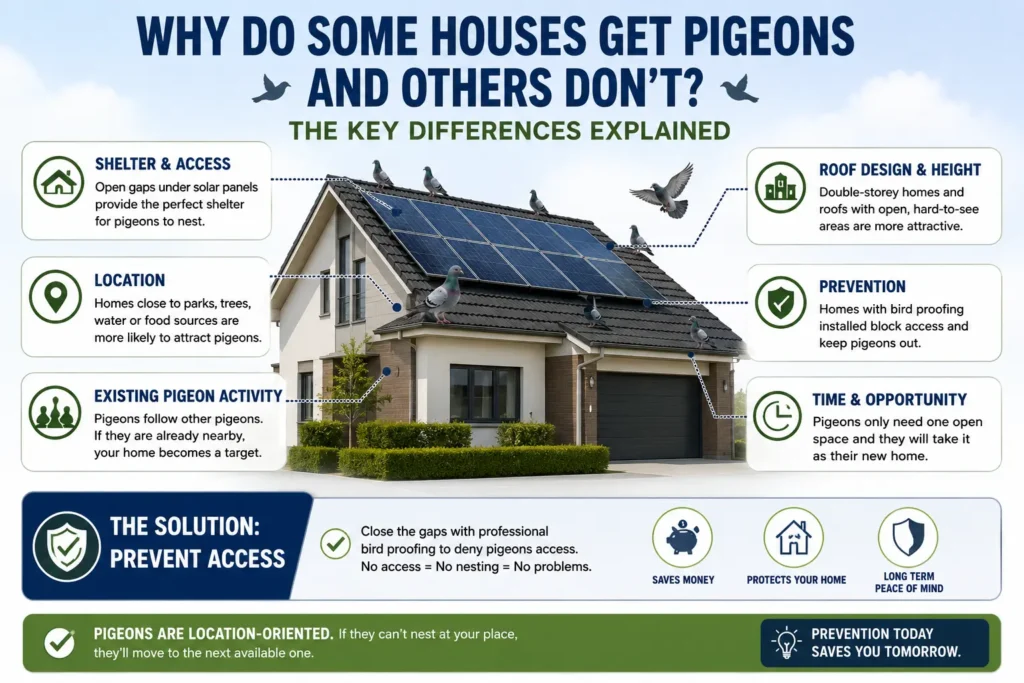
Accessible Space Under The Solar Panels
This is probably the biggest factor.
Pigeons aren’t attracted to the solar panels themselves.
They’re attracted to the sheltered gap underneath them.
That space provides:
- Warmth
- Shelter from rain
- Protection from predators
- A stable nesting environment
We discuss this in more detail in Do Solar Panels Attract Birds?
If pigeons can easily access that space, there is a greater chance they may attempt to nest there.
Double-Storey Homes Often Seem More Attractive
One pattern I’ve noticed over the years is that pigeons often seem to favour higher homes.
For example:
If there are ten single-storey homes in a street and one double-storey home, the pigeons often seem more interested in the taller property.
Now, this isn’t always the case.
We install bird proofing on plenty of single-storey homes.
But if I had to choose one trend I’ve observed repeatedly, it would be that double-storey homes appear to attract more activity.
My personal opinion is that higher roofs probably feel safer to the birds, although it’s impossible to know exactly what goes through a pigeon’s mind.
Existing Pigeon Activity In The Area
Another major factor is what is happening around your property.
If you regularly see:
- Pigeons flying around the neighbourhood
- Pigeons feeding nearby
- Pigeons sitting on neighbouring roofs
- Other homes with bird proofing installed
Then there is a good chance pigeons are already active in the area.
In many cases, homeowners don’t have a pigeon problem until nearby birds start looking for a new nesting location.
When Neighbours Install Bird Proofing
This is something we’ve seen many times.
A homeowner installs solar panel bird proofing.
The pigeons lose access to that roof.
Now they need somewhere else to go.
Often, the closest available solar system becomes the next target.
We’ve seen situations where a property had no bird issues for years, only to suddenly develop a nesting problem after neighbouring homes started blocking access underneath their panels.
Previous Nesting History Matters
Pigeons are very location-oriented.
Once they successfully nest somewhere, they tend to remember that location.
That’s why homeowners often report:
- A few pigeons one year
- A quiet period
- Then the pigeons return
And often they don’t come back alone.
This behaviour is one reason small problems can quickly become much larger problems.
We explain this in greater detail in Can Pigeons Come Back After Solar Panel Bird Proofing?
Comparison Table: Factors That May Increase The Chances Of Pigeons Nesting
Many homeowners assume there must be one specific reason pigeons chose their house. In reality, it’s usually a combination of factors.
The table below summarises some of the patterns we’ve observed over the years.
| Factor | Likely Impact |
|---|---|
| Accessible gap under solar panels | High |
| Existing pigeon activity nearby | High |
| Previous nesting history | High |
| Nearby homes installing bird proofing | Moderate to High |
| Double-storey home | Moderate |
| Roof material | Low |
| Solar panel brand | Very Low |
| House age | Very Low |
As you can see, accessibility and local pigeon activity appear to matter far more than things like roof type or solar panel brand.
Why Some Homes Never Get Pigeons
The opposite question is also worth asking.
Why do some homes never seem to develop a problem?
Again, there isn’t one single answer.
But often these homes:
- Have little pigeon activity nearby
- Have already been bird proofed
- Have limited access underneath the panels
- Have never been discovered by nesting birds
The important thing to understand is that just because you don’t have pigeons today doesn’t mean you’ll never have them.
Sometimes all it takes is a nearby nesting site being removed for the birds to start exploring new options.
How To Tell If Pigeons Have Already Chosen Your Roof
Many homeowners don’t realise birds are nesting under their solar panels until the problem is well established.
Some common warning signs include:
- Pigeons on the roof every day
- Early morning cooing and scratching sounds
- Droppings around the panels
- Nesting material in gutters
- Birds flying underneath the panels
- Blocked light underneath the panel edges
If you’re unsure, our guide on How To Tell If Birds Are Nesting Under Your Solar Panels explains what to look for.
Prevention Is Better Than Waiting
One thing I’ve learned from years of dealing with pigeon problems is that prevention is almost always easier than repair.
A lot of homeowners wait because:
- The problem seems small
- There are only one or two birds
- The pigeons disappear for a while
But that’s often how major infestations begin.
Most severe nesting jobs I’ve seen started with only a couple of birds.
By the time homeowners decide to act, there can be:
- Multiple nests
- Heavy contamination
- Blocked gutters
- Roof damage
- Reduced solar performance
This is why many homeowners choose preventative solar panel bird proofing before a serious problem develops.
Final Thoughts
If you’ve ever looked at your neighbour’s house and wondered why the pigeons chose your roof instead of theirs, you’re not alone.
The reality is that there isn’t always a clear answer.
From what we’ve observed over the years, factors like:
- Accessible space under the panels
- Existing pigeon activity
- Previous nesting history
- Nearby bird proofing installations
all seem to play a role.
But sometimes pigeons simply choose one suitable roof over another.
The important thing isn’t necessarily understanding why they chose your house.
It’s recognising the problem early and preventing it from becoming something much bigger.
Frequently Asked Questions
Why do pigeons choose one house over another?
In many cases there is no obvious reason. If several homes have suitable nesting areas, pigeons may simply choose one location over another.
Are pigeons attracted to certain roof materials?
Based on our experience, roof material doesn’t appear to be a major factor. We’ve seen nesting on both tiled and Colorbond roofs.
Do double-storey homes get more pigeons?
Double-storey homes often seem to attract more activity, although pigeons also commonly nest on single-storey homes.
Can pigeons move from a neighbour’s house to mine?
Yes. This happens quite often when neighbouring properties install bird proofing and the pigeons need to find a new nesting location.
Do solar panels attract pigeons?
The solar panels themselves don’t attract pigeons. The sheltered gap underneath them is what attracts nesting birds.
If pigeons leave, does that mean the problem is gone?
Not necessarily. Pigeons often return to previous nesting locations during future breeding cycles.
What’s the best way to stop pigeons nesting under solar panels?
The most effective long-term solution is professionally installed solar panel bird proofing, which blocks access underneath the panels while maintaining airflow.
Should I bird proof my solar panels before I have a problem?
In many cases, yes. Prevention is usually easier and more affordable than dealing with a large established nesting problem later.