
A lot of Brisbane homeowners notice pigeons suddenly sitting on the roof after installing solar panels and immediately wonder:
“Do solar panels actually attract birds?”
The short answer is: not exactly.
The solar panels themselves are not attracting birds like a magnet.
What birds are actually attracted to is the sheltered space underneath the panels.
That small gap between the roof and the solar system creates a warm, protected nesting area that pigeons absolutely love.
And once birds successfully nest there, they often keep returning to the same location again and again.
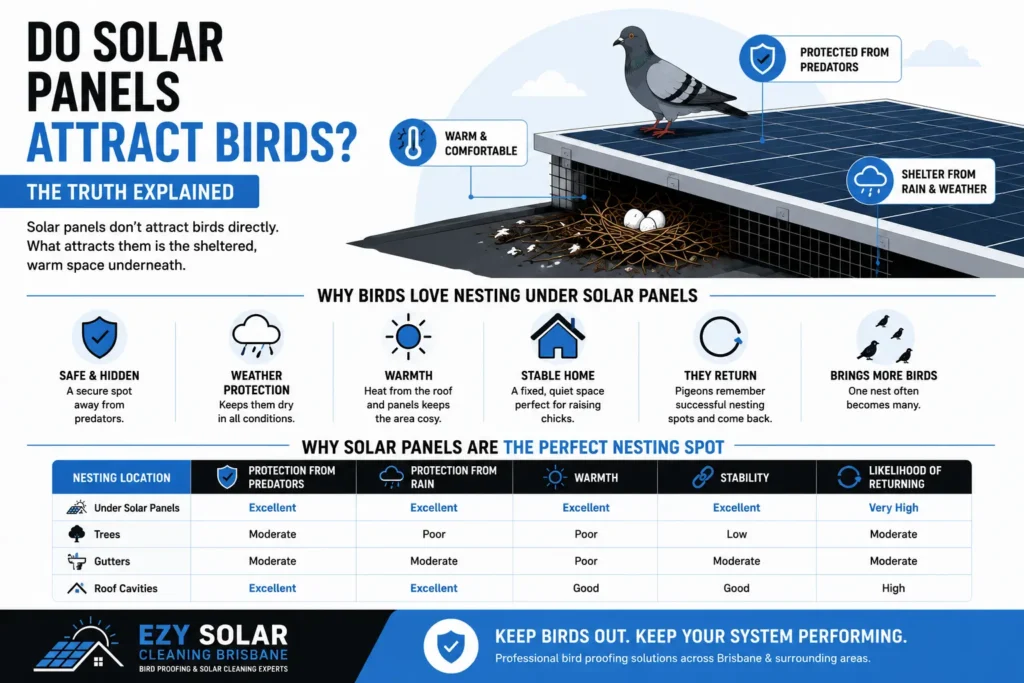
Why Birds Like Nesting Under Solar Panels
From a bird’s perspective, the space underneath solar panels offers several advantages compared to other common nesting locations. It provides warmth, shelter from the weather and protection from predators, which is why pigeons often choose solar panels over trees, gutters and other exposed areas.
The table below compares some of the most common nesting locations and shows why solar panels are often the most attractive option.
| Nesting Location | Protection From Predators | Protection From Rain | Warmth | Stability | Likelihood of Returning |
|---|---|---|---|---|---|
| Under Solar Panels | Excellent | Excellent | Excellent | Excellent | Very High |
| Trees | Moderate | Poor | Poor | Low | Moderate |
| Gutters | Moderate | Moderate | Poor | Moderate | Moderate |
| Roof Cavities | Excellent | Excellent | Good | Good | High |
Unlike trees that move around in the wind and get exposed to weather, the area underneath solar panels stays relatively protected all year round.
From our experience working on bird proofing jobs across Brisbane, we’ve repeatedly seen pigeons choosing solar systems because the nesting area remains sheltered and consistent. Unlike a tree branch that can move, break or become exposed during storms, the gap under the panels stays much the same year after year.
This is one reason many Brisbane homeowners eventually install solar panel bird proofing once pigeons become established underneath the panels.
Why Pigeons Keep Coming Back
One of the biggest reasons pigeon problems grow over time is because pigeons are extremely location-oriented.
Once they successfully nest somewhere, they usually remember that location and return during future nesting cycles.
We’ve seen many situations where:
Pigeons nested under the panels once
Temporarily disappeared
Homeowners thought the problem was solved
The same pigeons returned months later
More pigeons arrived with them
Over time, the nesting area becomes:
Larger
Dirtier
More established
Harder to clean
Many homeowners describe it as if the problem suddenly exploded, but in reality, the birds have usually been returning repeatedly over time.
This behaviour is explained further in How Long Do Pigeons Stay Under Solar Panels?
Do Solar Panels Attract Certain Types Of Birds?
While pigeons are by far the most common birds we see nesting under solar panels, they are not the only ones.
Every now and then we also encounter:
Small native birds
Mynas
Sparrows
Possums seeking shelter
However, pigeons are by far the biggest issue because they:
Nest in groups
Return repeatedly
Produce large amounts of droppings
Expand nests over time
This is why most bird proofing work is specifically focused on preventing pigeons from accessing the space underneath the panels.
Do Certain Homes Attract More Birds?
From what we’ve seen throughout Brisbane, pigeons don’t seem to care much about:
Roof material
Tile roofs versus Colorbond roofs
Solar panel brands
Roof colour
As long as there is a gap underneath the panels, they are usually happy.
One interesting observation we’ve noticed is that double-storey homes often seem more attractive than lower homes nearby.
For example, if there is a street with mostly single-storey homes and one taller home in the middle, pigeons often appear to favour the higher roofline.
It’s not a rule, and we still bird proof plenty of single-storey homes, but higher roofs do seem to attract more activity in many situations.
Sometimes The Birds Come From Nearby Homes
A lot of homeowners are surprised when they suddenly develop a pigeon problem despite never seeing one before.
What often happens is:
A neighbour installs bird proofing
The pigeons lose access to that roof
The birds start looking for a new nesting location
They move to nearby homes with open access underneath the panels
We’ve seen this happen many times.
One property gets professionally bird proofed, and within months another nearby property starts seeing increased pigeon activity.
That’s one reason prevention is usually easier than waiting for a nesting problem to develop.
Many homeowners choose bird proofing before a major nesting problem starts.
How Can You Tell If Birds Are Nesting Under Your Solar Panels?
A lot of people assume pigeons sitting on the roof is normal.
And sometimes it is.
But the important thing is recognising patterns.
If you notice:
Pigeons on the roof every day
Birds constantly flying in and out
Early morning cooing and scratching
Droppings around the panels
Nesting material in gutters
Large clumps visible underneath the panels
Then there’s a good chance birds are already nesting there.
One simple trick for double-storey homes is to walk further down the street and look back towards the roof. Often you can see the gap underneath the panels. If light is blocked by large clumps of nesting material, that’s often a clear sign of a nest.
We explain this process in more detail in How To Tell If Birds Are Nesting Under Your Solar Panels.
What Problems Can Birds Cause Under Solar Panels?
At first, the issue often seems like a minor annoyance.
A few birds.
A bit of noise.
Some droppings.
But over time, nesting underneath solar panels can create much bigger problems.
We’ve personally seen:
Blocked Gutters And Downpipes
Nesting material and droppings wash into gutters and create blockages.
Roof Damage
On metal roofs, bird droppings and constant activity can contribute to paint deterioration, scratches and corrosion.
Loose Electrical Cables
We’ve seen situations where years of nesting activity caused cables underneath the panels to become displaced or loose.
Fire Hazards
Large amounts of dry nesting material can build up underneath the panels where heat and electrical components are present.
Bird Lice
Some homeowners report bird lice entering roof spaces and living areas after long-term nesting problems.
Reduced Solar Performance
Dirty panels and restricted airflow can contribute to lower system performance over time.
Why DIY Bird Deterrents Usually Fail
Before calling a professional, many homeowners try DIY deterrents.
We’ve seen people use:
Fake snakes
Plastic owls
Reflective tape
CDs hanging from roofs
Noise machines
Vinegar sprays
Plastic mesh
Sometimes these methods work briefly.
But once pigeons have already nested underneath the panels, they usually become very determined to stay.
Eventually they realise:
The owl never moves
The snake isn’t real
The sound isn’t dangerous
The smell disappears after rain
And they simply continue nesting.
We discuss these methods further in How To Stop Pigeons On Solar Panels: Best Solutions That Actually Work.
So, Do Solar Panels Attract Birds?
Technically, no.
Solar panels do not attract birds by themselves.
What attracts birds is the protected nesting space underneath them.
To pigeons, that gap offers:
Shelter
Warmth
Protection
Stability
A familiar nesting environment
And once they move in, they often keep returning until access is properly blocked.
Prevention Is Better Than Waiting
One thing we always tell homeowners is that prevention is almost always easier and cheaper than waiting.
Most nesting problems begin with:
One or two birds
A small nest
Light roof activity
But over time, those small problems can turn into:
Multiple nests
Significant contamination
Gutter blockages
Roof damage
Expensive clean-up work
If you suspect birds may already be using the space underneath your solar panels, it’s worth investigating early before the problem becomes established.
Frequently Asked Questions
What's the best way to stop birds nesting under solar panels?
The most effective long-term solution is solar panel bird proofing, which physically blocks access underneath the panels while maintaining airflow.
Will pigeons leave on their own?
Sometimes they temporarily leave between nesting cycles, but they often return if access underneath the panels remains open.
How do I know if birds are living under my solar panels?
Look for repeated roof activity, droppings, nesting material, noise early in the morning and birds constantly flying underneath the panels.
Can birds damage solar panels?
Yes. Long-term nesting activity can contribute to contamination, cable issues, blocked airflow and other maintenance problems.
Are pigeons under solar panels dangerous?
Over time, nesting can contribute to blocked gutters, roof contamination, cable issues, hygiene concerns and reduced solar performance.
Do all homes with solar panels get pigeons?
No. However, any home with accessible gaps underneath the panels can potentially attract nesting birds.
Why do birds nest under solar panels?
The area underneath solar panels provides warmth, protection from rain, shelter from predators and stable nesting conditions.
Do solar panels attract pigeons?
Not directly. Pigeons are mainly attracted to the sheltered gap underneath the panels where they can safely build nests.