
If you keep hearing scratching, fluttering, or cooing noises from the roof early in the morning, there’s a good chance birds may already be nesting under your solar panels.
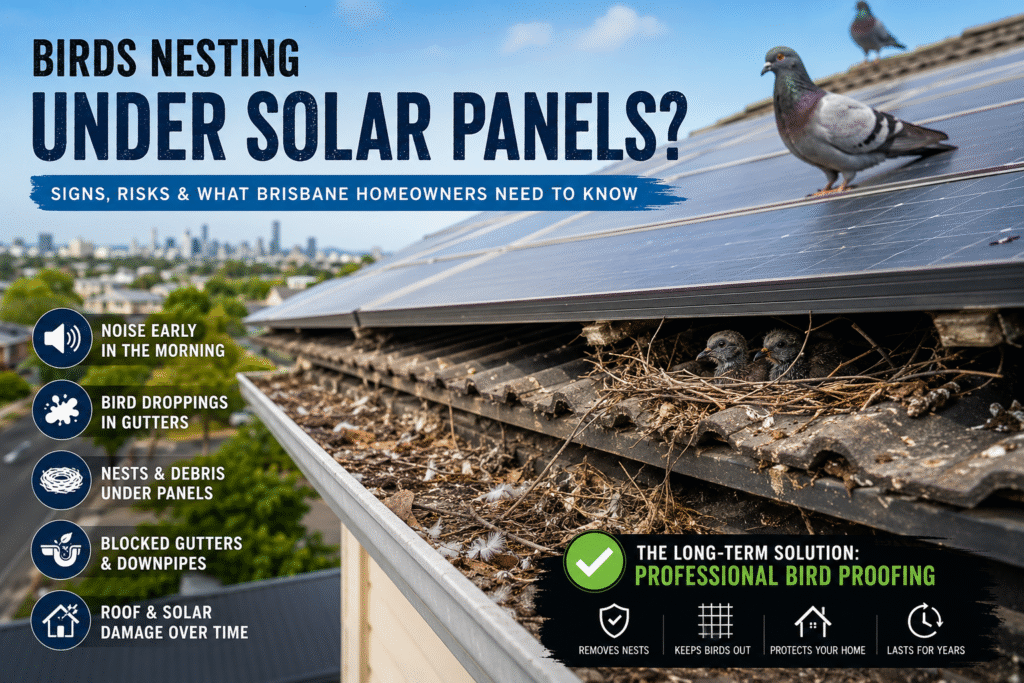
This is becoming a very common problem across Brisbane, especially on homes with solar panels that leave enough space underneath for pigeons to move in and build nests.
The tricky part is that many homeowners don’t realise how bad the problem is until it’s already gotten out of control.
At EZY Solar Cleaning, we regularly inspect homes where people originally thought:
- “It’s probably just a couple of birds”
- “They’ll leave eventually”
- “It’s not causing any real damage”
…but once we get up on the roof, we often find multiple nests, blocked gutters, loose wiring, heavy droppings, and years of built-up debris hidden underneath the panels.
In this guide, we’ll go through the most common signs birds are nesting under solar panels, what homeowners usually miss, and what to do before the problem gets worse.
The Most Common Signs Birds Are Nesting Under Solar Panels
1. Noise Early in the Morning
This is usually the first thing homeowners notice.
People often describe:
- scratching noises
- flapping sounds
- constant cooing
- movement underneath the roof area
The noise is normally worse early in the morning when the birds become active.
A lot of Brisbane homeowners initially think the sound is coming from gutters, possums, or trees nearby, but once the nesting starts growing, the noise becomes much more obvious.
If the sounds are happening consistently around the same section of the roof where the solar panels are installed, it’s a strong sign birds may already be living underneath.
2. Bird Droppings Around the Gutters or Garden
Another major sign is seeing droppings building up around:
- gutters
- downpipes
- outdoor areas
- pathways
- patios
- sections of the garden directly below the panels
One thing we often notice during inspections is that only the gutter section underneath the solar panels is heavily affected.
That’s usually a giveaway that nesting activity is happening directly above it.
If you’re constantly cleaning droppings from the same area of the property, it’s worth checking underneath the panels properly.
3. Grass, Sticks, or Nesting Material in the Gutters
This is one of the biggest warning signs homeowners ignore.
Many people assume:
“The gutters are just dirty because of nearby trees.”
But if you start seeing:
- dry grass
- sticks
- feathers
- nesting debris
- eggshells
especially around the solar panel area, there’s a good chance birds are carrying nesting material underneath the system.
We’ve inspected many Brisbane homes where the gutters were completely packed with nesting debris directly beneath the panels.
4. Pigeons Constantly Sitting on the Roof
Birds land on roofs occasionally everywhere in Brisbane.
That alone doesn’t always mean nesting.
The problem is when you repeatedly notice:
- pigeons flying in and out from the same spot
- birds sitting near the panels all day
- multiple pigeons returning every morning
- birds disappearing underneath the panels
At that point, they’re usually not just visiting — they’re living there.
5. You Can Actually See the Nest From the Ground
This is something most homeowners never think to check.
If you stand far enough back from the house, especially on double-storey homes, you can often look up and see the gap between the roof and the solar panels.
Normally, light comes through that gap evenly.
But when birds build nests underneath, you may notice:
- dark clumps
- grass sticking out
- blocked sections underneath the panels
If you can visibly see material packed underneath the system, the birds are definitely nesting there.
Why Double-Storey Homes Often Get More Pigeon Problems
We see pigeon activity on both single and double-storey homes across Brisbane.
But double-storey homes often get targeted more heavily.
One reason is simply height.
If most homes nearby are low-set and one property sits much higher than the others, pigeons tend to prefer the elevated roofline because it feels safer and more protected.
That doesn’t mean single-storey homes are safe though.
If there’s enough gap underneath the panels, pigeons will happily move in regardless of roof type.
We see nesting on:
- Colorbond roofs
- tiled roofs
- modern homes
- older homes
The roof material itself usually doesn’t matter much.
What Homeowners Usually Get Wrong
One of the biggest misconceptions is thinking:
“It’s only a couple of birds.”
Most serious infestations actually start small.
At first:
- there may only be one small nest
- the noise is minor
- the mess is manageable
Then the birds return during future nesting cycles.
Over time:
- more birds arrive
- more nests get built
- droppings build up
- gutters clog
- damage starts appearing
We’ve seen situations where homeowners ignored the problem for too long and eventually ended up with:
- multiple nests
- dead birds under the panels
- corrosion on roofing
- scratched Colorbond roofing
- loose solar cables
- severe gutter blockages
- bird lice problems inside the house
One of our customers only noticed some grass in the gutters at first.
By the time we inspected the roof, there were between six and ten nests underneath the system.
DIY Bird Deterrents Usually Don’t Work Long-Term
Over the years, we’ve seen homeowners try almost everything:
- vinegar sprays
- plastic snakes
- fake owls
- reflective tape
- hanging CDs
- ultrasonic noise devices
Some may scare birds temporarily.
But once pigeons have already built nests and settled underneath the panels, they usually come back quickly.
The reason is simple:
the birds aren’t sitting on the roof randomly.
They’re protecting a nesting area underneath the panels.
That’s why temporary deterrents rarely solve the actual problem.
What Happens If You Ignore Birds Under Solar Panels?
The longer birds stay underneath the panels, the worse the situation usually becomes.
Over time, homeowners may start dealing with problems caused by birds under solar panels like:
- stronger odours
- increasing noise
- larger bird populations
- blocked gutters
- overflowing downpipes
- more droppings around the property
- roof damage
- solar panel contamination
- loose wiring underneath the system
The cleanup also becomes significantly bigger and more expensive once multiple nesting cycles have occurred.
Another thing many people don’t realise is that pigeons become very attached to established nesting locations.
Even after professional bird proofing is installed, heavily established pigeons may continue returning to the roof for a while because they’re used to nesting there.
Eventually they move on once they realise they can no longer access the space underneath the panels.
How Professional Solar Panel Bird Proofing Works
Professional bird proofing focuses on solving the root cause of the problem:
access underneath the panels.
At EZY Solar Cleaning, the process normally includes:
- inspecting the nesting activity
- removing nests and debris
- cleaning underneath the panels
- installing bird proofing mesh around the perimeter
- securing the mesh using solar-safe mounting methods
- taking before and after photos for the homeowner
We use:
- UV-resistant PVC-coated stainless steel mesh
- aluminum solar clips
- non-drilling installation methods
This allows the gap underneath the panels to be sealed properly without drilling into the roof or solar system.
Depending on the condition of the roof, some homeowners also choose optional:
- solar panel cleaning
- gutter cleaning
at the same time.
One Piece of Advice for Brisbane Homeowners
If you have solar panels, make an effort to check underneath them before the problem becomes obvious.
Even if:
- the noise seems minor
- you only see a couple of pigeons
- the gutters just look slightly dirty
…it’s worth investigating early.
Some homeowners use:
- drones
- roof inspections
- gutter cleaners
- solar maintenance visits
just to confirm whether nesting has started.
Because once birds establish themselves underneath the system, the problem usually keeps growing over time.
Catching it early is almost always easier, cleaner, and cheaper than waiting until multiple nests and years of buildup develop underneath the panels.
Frequently Asked Questions
Do pigeons damage solar panels?
They usually damage the area around the panels more than the panels themselves.
We commonly see:
- droppings
- nesting debris
- loose wiring
- blocked gutters
- roof corrosion
- contamination underneath the system
Can birds cause solar panel performance issues?
Heavy droppings and debris buildup can affect solar panel cleanliness and potentially reduce performance over time.
How do I stop pigeons nesting under solar panels?
The most reliable long-term solution is professionally installed bird proofing mesh that blocks access underneath the panels.
Temporary deterrents often fail once birds have already established nests.
Are bird nests under solar panels dangerous?
They can become a health and maintenance issue over time, especially when droppings, parasites, blocked gutters, or loose wiring are involved.
The longer the nesting continues, the larger the cleanup usually becomes.
Do birds eventually leave on their own?
Sometimes birds leave temporarily between nesting cycles, but they often return to the same location later.
That’s why many Brisbane homeowners notice the problem getting worse over time instead of disappearing completely.