
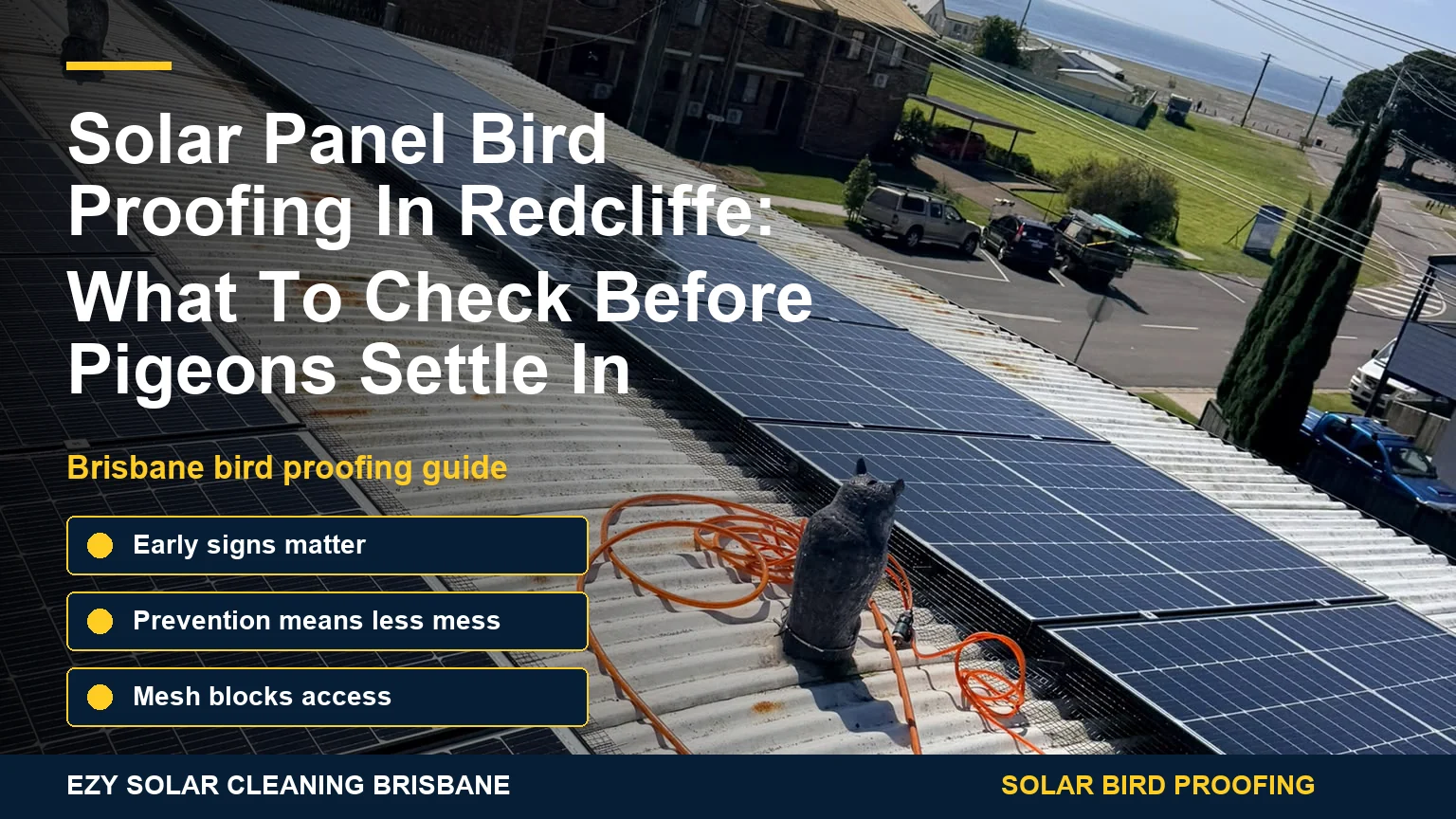
The best time to think about solar panel bird proofing is before a few visiting pigeons turn the roof into a regular nesting location. Around Redcliffe, homeowners often notice birds repeatedly landing on the array, walking along the panel edges or returning at the same time each morning. Those habits can be an early warning even before sticks and droppings become obvious.
Pigeons are strongly attached to places that give them reliable shelter. Once the space under a solar system has been used successfully, a temporary quiet period does not necessarily mean the problem has resolved. Closing the access early is usually cleaner and simpler than waiting for several nesting cycles.
Visiting, roosting or nesting?
An occasional pigeon sitting on the ridge is different from a pair disappearing under the panels every day. The important clue is repetition.
Birds may be starting to settle when you notice:
- repeated landings on the same corner of the array
- pigeons walking along the gutter toward the panels
- birds entering a dark gap beneath the panel frame
- cooing or scratching early in the morning
- sticks carried onto the roof
- droppings concentrating below one part of the system
- more pigeons appearing over time
Watch only from a safe position. Do not climb onto a tiled or metal roof to check beneath panels yourself.
Why early proofing is usually the easier job
Before nesting starts, the main task is to close the perimeter properly. After pigeons establish themselves, the job may also involve nests, feathers, droppings, dead birds, blocked gutter sections and contamination beneath the panels.
That extra mess can affect the scope and cost. It can also make the problem much more unpleasant for the household, particularly when morning noise affects sleep or droppings fall near paths, cars and outdoor areas.
The Brisbane article about bird proofing before pigeons move in explains when prevention makes sense and when monitoring may be reasonable.
What bird mesh actually does
Solar bird mesh is a physical barrier fitted around the exposed edge of the panel array. Its purpose is specific: prevent birds from entering the sheltered gap beneath the panels.
It does not stop every pigeon from flying over the property or landing briefly on the roof. Birds may inspect the array after installation, especially if they previously nested there. A successful installation removes access to the nesting space.
What a complete Redcliffe installation should cover
The visible front edge is only one part of an array. Birds can use rear edges, corners, raised sections and gaps between panel rows. A proper assessment should consider the entire system.
| Area | Why it needs attention |
|---|---|
| Front and side edges | Often visible, but not the only entry points |
| Rear panel edge | Easy to miss from the ground |
| Corners | Poor shaping can leave a usable opening |
| Gaps between rows | May connect to the space under the array |
| Second panel array | Birds can relocate if it remains open |
Suitable stainless steel mesh and stainless steel clips provide a stronger long-term approach than plastic products that can deteriorate on a hot roof. The mesh should be shaped neatly to the roof profile without drilling into the panels or roof.
For the core service details, see solar panel bird proofing in Brisbane.
Why nearby bird proofing can change local activity
Pigeons do not always disappear when a neighbouring home installs mesh. They may search nearby for another sheltered array. That does not mean every surrounding property will develop a problem, but it is a sensible reason to watch repeated activity more closely.
This pattern also explains why two similar homes in one street can have very different experiences. Roof pitch, panel layout, access gaps and previous nesting history all influence which shelter the birds choose.
Do panels need cleaning as well?
Clean panels and bird-proofed panels are related but separate outcomes. If the glass has heavy droppings or grime, cleaning may be worthwhile. If pigeons are underneath the array, cleaning the surface alone will not prevent the next round of mess.
Ask the provider to explain whether the quote includes nest removal, loose debris removal, panel cleaning and before-and-after photos. A single total without a clear scope is difficult to compare.
What to send when requesting a quote
A useful quote request should include:
- the Redcliffe-area suburb
- approximate number of panels
- number of separate arrays
- single or double-storey access
- tile, metal or other roof type
- whether birds are currently entering beneath the panels
- visible droppings, nests or gutter contamination
- safe ground-level photos of the roof and panel layout
The Redcliffe location page confirms local service coverage. Providing these details helps the installer assess whether the job is preventative mesh or an established nesting clean-up.
When waiting is reasonable
If there are no birds entering, no repeated landings and no signs of roof mess, monitoring can be reasonable. Check occasionally from the ground and pay attention to changes.
Waiting becomes less sensible when the same birds return daily, disappear beneath the panels or start carrying material. Prevention is most valuable before the sheltered space has become a familiar nesting location.
FAQ
Do solar panels attract pigeons in Redcliffe?
The attraction is the sheltered physical gap, not the solar electricity. Panels can provide shade, cover and a stable nesting space.
Can pigeons return after disappearing for a few weeks?
Yes. Quiet periods can occur between nesting cycles, and birds may return to a successful location.
Is bird mesh suitable for tiled and metal roofs?
It can be installed on different roof types, but the mesh must be shaped carefully to the panel and roof profile.
Does the mesh stop airflow?
Proper bird mesh blocks bird access while leaving the openings in the mesh available for ventilation.
Should nests be removed before mesh is fitted?
Existing nests and loose debris should be addressed as part of the agreed job scope before access is closed.
How do I know whether the whole array was protected?
Ask for a clear scope and before-and-after photographs showing the perimeter and important corners.