
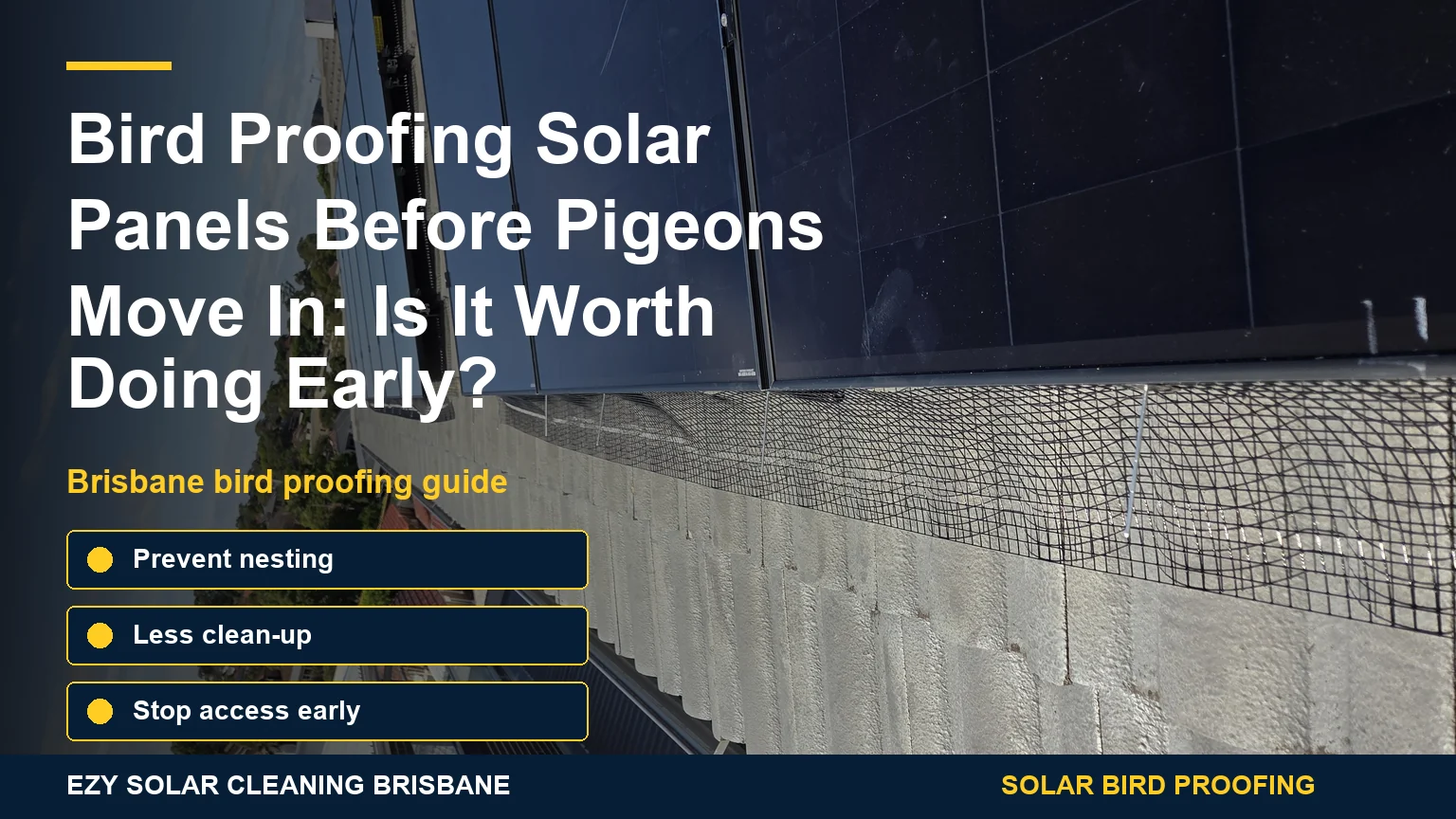
Yes, early bird proofing can be worth it when the roof is likely to attract pigeons, when nearby homes already have bird activity, or when you want to avoid the mess and stress that comes after nesting starts. It is usually easier to block access before there are nests, droppings and debris under the panels.
That does not mean every Brisbane home must be bird proofed the day solar panels are installed. Pigeons are unpredictable. Some roofs never have a problem. But if birds are already common in the area or you have seen them inspecting the panel edges, early prevention can make a lot of sense.
Why prevention is usually cleaner
Once pigeons start using the gap under solar panels, they can bring in sticks, feathers and nesting material. Droppings can collect on the roof, around gutters and sometimes on the panels themselves. The homeowner may first notice noise, smells, mess near outdoor areas, or one gutter section becoming heavily contaminated.
Bird proofing before that stage is simpler because the job is mainly about blocking access. After nesting starts, the job may also involve nest removal, debris clean-out and solar panel cleaning after bird mess.
Brisbane does not have a simple pigeon off-season
In colder places, bird activity may feel more seasonal. In Brisbane, the warm climate means pigeon nesting can continue through much of the year. Demand for bird proofing is often busiest from mid September through February, but problems can still appear outside that period.
This matters because waiting for the birds to “finish the season” can backfire. Pigeons may disappear for a while and return later to the same roof. The owner experience notes are consistent on this point: pigeons are location-oriented. If a roof works for them once, they may remember it.
When early bird proofing is most sensible
Early prevention is most worth considering when there are already signs of bird pressure nearby. That might include pigeons on neighbouring solar systems, droppings below your roofline, birds landing on your panels, or a previous pigeon issue before solar was installed.
| Situation | Early bird proofing value |
|---|---|
| Pigeons are already common on nearby roofs | Higher value because birds may test your panels next |
| Brand new solar system with open panel gaps | Worth considering before nesting starts |
| Birds are landing on panel edges daily | Stronger sign that prevention may be needed soon |
| No birds in the area and no roof activity | Monitor first may be reasonable |
| Neighbour recently bird proofed their panels | Birds may look for another sheltered roof nearby |
Why new solar panels can create a new shelter
Solar panels do not attract birds because of electricity. They attract birds because of the physical shelter. The gap underneath can provide shade, warmth, protection from rain and a stable nesting area that does not move like a tree.
This is why a roof that never had a pigeon issue can develop one after solar is installed. The panels create a new protected space. If pigeons find it, they may keep coming back.
The guide on why pigeons like solar panels explains this behaviour in more detail.
The cost of waiting is not only money
Waiting can add cleaning and frustration. Homeowners often call after sleep has already been affected by early morning cooing or scratching. Others call after bird droppings appear around patios, paths, cars, gutters or children’s play areas.
In heavier cases, there can be multiple nests, blocked gutters, droppings, loose debris and roof contamination. Early prevention aims to avoid that chain of problems rather than clean it up later.
Does early bird proofing guarantee birds will never sit on the roof?
No. Bird proofing is not a force field around the house. Birds may still land on the roof or inspect the panels. The purpose is to stop them getting underneath the solar array where they can nest.
That distinction is important. A successful job is not judged by whether a pigeon ever appears on the roof again. It is judged by whether the access under the panels is blocked.
For more on what happens after installation, see the guide on pigeons returning after bird proofing.
What early installation should include
Preventative bird proofing should still be a proper installation. It should use suitable mesh, stainless steel clips where relevant, careful corner work and full perimeter coverage. It should not be a quick strip of weak mesh along the most visible edge.
EZY Solar Cleaning provides solar panel bird proofing in Brisbane for existing pigeon problems and preventative work where homeowners want to block access before nesting builds up.
When monitoring first is reasonable
If there are no birds in the area, no droppings, no roof noise and no nearby pigeon pressure, you may choose to monitor first. A sensible middle ground is to check safely from the ground every so often and pay attention to repeated bird activity.
If you start seeing the same birds return to the panel edge, do not ignore it for months. Early signs are much easier to deal with than a roof full of nesting material.
FAQ
Should I bird proof solar panels as soon as they are installed?
It can be worthwhile if pigeons are active nearby or you want prevention from the start. If there is no bird pressure, monitoring may be reasonable.
Is early bird proofing cheaper?
It can reduce extra clean-up work because there may be no nests or droppings to remove yet, but quotes still depend on the roof and panel layout.
Can pigeons appear after years with no problem?
Yes. Pigeons can be unpredictable, and local movement can change when nearby roofs are blocked or new shelters appear.
Will early mesh look ugly?
A neat black mesh installation usually blends with the panel frame better than improvised deterrents or later mess from nesting.
Does bird proofing scare pigeons away?
No. It physically blocks access under the panels. Birds may still inspect the roof at first.
What signs mean I should stop waiting?
Repeated landing, morning cooing, scratching, droppings below the panels or birds carrying sticks are all signs to take seriously.