
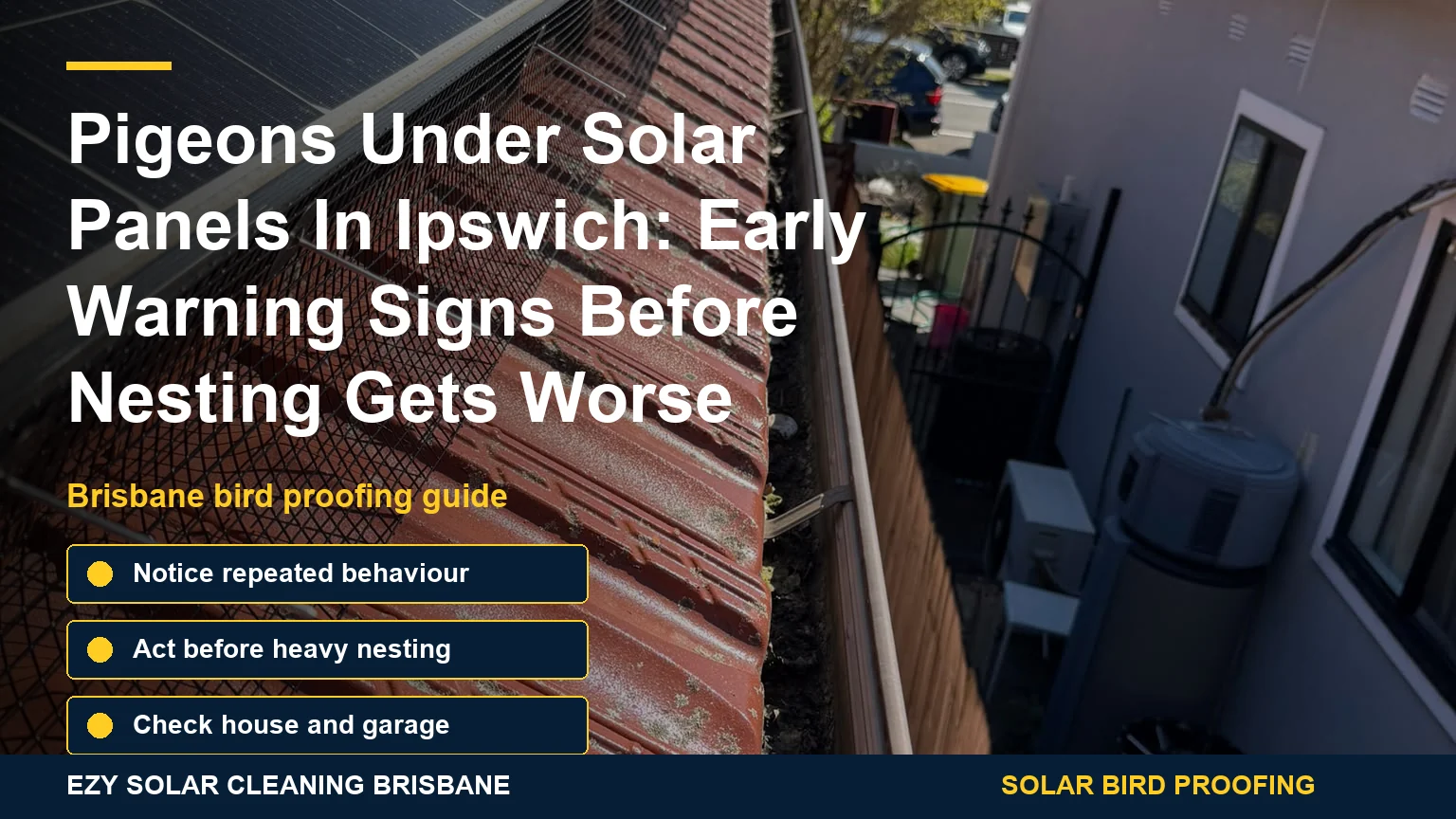
The earliest sign of a pigeon problem is often not a visible nest. Ipswich homeowners may first notice the same pair landing near the panels each morning, walking toward one corner or disappearing briefly beneath the frame. That repeated behaviour matters more than an occasional bird resting on the roof.
Acting early does not mean every pigeon visit requires mesh. It means recognising when a roof is changing from a casual landing place into a dependable shelter, before nests, droppings and gutter debris become a larger clean-up.
The progression from visiting to nesting
Pigeon activity usually develops in stages. Understanding the pattern helps homeowners avoid both overreacting to one visit and ignoring clear signs for months.
| Stage | Typical sign | What to do |
|---|---|---|
| Occasional visit | A bird rests on the ridge and leaves | Monitor safely |
| Repeated inspection | The same birds land near one panel edge | Watch for entry underneath |
| Regular roosting | Morning cooing, feathers or concentrated droppings | Arrange an assessment |
| Active nesting | Sticks, birds carrying material or frequent entry | Discuss removal, cleaning and exclusion |
| Established problem | Heavy mess, blocked gutter sections or multiple birds | Obtain a clear full-scope quote |
Pigeons can also be quiet at times. A lull does not prove that an established site has been abandoned permanently.
Early clues homeowners often miss
The most useful clues appear around the routine of the birds:
- landings at a similar time each day
- walking along the gutter toward the array
- dropping out of sight below the panel edge
- cooing or scratching above a bedroom
- a growing patch of droppings on one path or wall
- feathers collecting near a downpipe
- sticks appearing in a gutter without an obvious nearby tree nest
- activity moving between house and garage panels
The broader guide on how to tell if birds are nesting under solar panels can help distinguish active entry from general bird activity.
Why waiting can change the job
Before birds settle, the work may be mainly preventative: assess the full array and close the exposed perimeter. After repeated nesting, the scope may include nests, loose debris, droppings on the panels, contaminated roof areas and gutter material.
That does not mean homeowners should be frightened into rushing. It means a quote should reflect the real condition. Early prevention and established-nest remediation are not identical jobs, and the cost should not be compared as though they are.
What proper prevention looks like
Solar bird mesh forms a physical barrier around the accessible edges of the array. Suitable stainless steel mesh and stainless steel clips provide a durable approach for exposed rooftop conditions. The mesh should be shaped to the tile or metal profile and installed without drilling into the panels or roof.
Coverage should include more than the edge facing the street. Rear edges, corners, row gaps and additional arrays all need assessment. If the main house is protected but the garage remains open, pigeons may simply move to the easier shelter.
Professional solar panel bird proofing explains the core service and the role of the barrier.
Prevention is different from deterrence
Fake owls, reflective tape and other scare devices may change bird behaviour briefly. Pigeons often become accustomed to stationary objects, especially when a warm, protected panel gap remains available.
Mesh does not depend on continuing to frighten the birds. It removes their access. Returning pigeons may still land and inspect the roof, but they should not be able to reach the nesting space if the perimeter is complete.
The article about bird proofing before pigeons move in discusses when preventative installation is worthwhile.
What to include in an Ipswich quote request
Provide practical details rather than trying to diagnose everything yourself:
- Ipswich suburb
- approximate number of panels
- house and garage arrays
- roof material and storey height
- where birds usually land or enter
- visible nests, droppings or gutter mess
- any old mesh already fitted
- safe, wide ground-level photographs
The Ipswich location page confirms local coverage. Do not climb onto the roof to inspect or take close photographs. Roof access and solar equipment require appropriate safety procedures.
Questions that reveal whether a quote is complete
Ask whether the quote includes full-perimeter coverage, all arrays, nest and loose-debris removal, cleaning, stainless steel materials and completion photos. Also ask how the mesh will be attached and whether drilling is proposed.
Clear answers make quotes easier to compare. A low total may omit a second array or the clean-up that an established nest actually requires.
FAQ
Does one pigeon mean birds are nesting?
No. Repeated entry under the same panel edge is a more meaningful sign than one bird landing on the roof.
What time are the signs easiest to notice?
Early morning can reveal cooing, scratching and repeated departures, but activity varies between properties.
Will pigeons leave when the weather gets hotter?
They may change their routine, but the shaded panel gap can remain attractive. Heat alone is not reliable prevention.
Should I remove visible sticks myself?
Do not climb onto the roof. Loose material may be only part of a larger nest beneath the panels.
Can bird mesh be fitted before there is a nest?
Yes. Preventative proofing can be appropriate when repeated activity shows birds are targeting the array.
Is cleaning always included with bird proofing?
No. Ask exactly what nest removal, debris removal and panel cleaning are included in the quote.