
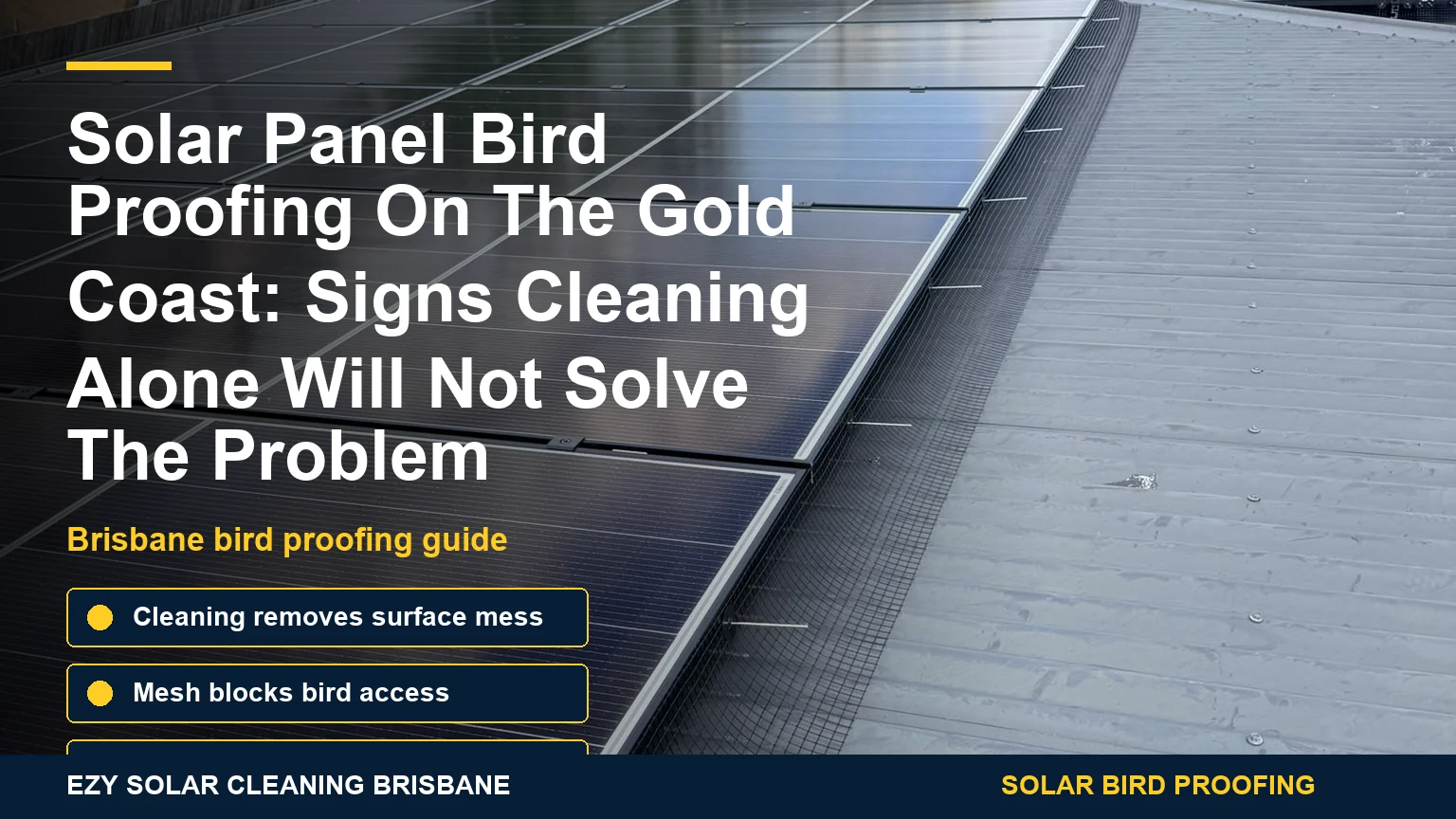
Solar panel cleaning can remove droppings, dust and grime from the glass, but it cannot stop pigeons entering beneath the array. If the same birds return after a clean, the underlying problem is access, not simply a dirty panel surface.
For Gold Coast homeowners, the distinction matters because cleaning and bird proofing solve different parts of the problem. Cleaning deals with residue already present. Properly fitted mesh prevents birds from using the sheltered space under the panels again.
The clearest signs this is more than a cleaning job
A one-off patch of droppings does not automatically mean birds are nesting. The stronger evidence comes from repeated behaviour around the same part of the array.
Look for:
- pigeons disappearing beneath the panel frame
- cooing or scratching around sunrise
- sticks protruding from an edge or collecting in gutters
- droppings returning soon after the panels were cleaned
- feathers and debris below one roof section
- unpleasant odours near an upper room or outdoor area
- birds shifting from the main roof to garage panels
These signs suggest the panel gap is being used as shelter. Washing the glass may improve appearance, but the birds can create new mess as soon as they return.
Cleaning and bird proofing have different jobs
| Service | What it addresses | What it does not do |
|---|---|---|
| Solar panel cleaning | Droppings, dirt and grime on accessible panel surfaces | Close access under the array |
| Nest and debris removal | Existing loose material beneath and around panels | Prevent rebuilding if gaps stay open |
| Bird mesh installation | Entry points around the panel perimeter | Remove every mark already on the glass |
| Gutter cleaning | Material collected in the gutter | Stop new nesting above it |
This is why a quote should describe the scope clearly. “Clean and bird proof” can mean very different things between providers. Ask which surfaces are cleaned, whether nests and loose debris are removed, whether every panel edge is included and whether separate arrays are covered.
The main solar panel cleaning serviceexplains the cleaning side, while solar panel bird proofing covers the physical exclusion work.
Why the mess often returns quickly
When pigeons have an established roost, they can spend hours around the same array each day. New droppings may appear on the panel glass, roof, gutter, paths or patio below. Rain can move some loose material, but it does not remove the sheltered nesting location.
The Gold Coast climate also means homeowners should not assume a long cold season will permanently end the activity. Birds can remain active across the year, and a temporarily empty nest can be reused later.
What a combined solution may involve
Where birds are already established, the work may need to happen in a logical order:
1. assess the complete array and identify every access point 2. remove nests and loose debris included in the agreed scope 3. clean affected panel surfaces where needed 4. shape and fit mesh around the exposed perimeter 5. check corners, row gaps and any second array 6. provide photos showing the completed barrier
Suitable stainless steel mesh with stainless steel clips offers a stronger long-term approach than plastic mesh or improvised wire. The installation should avoid drilling into the panels or roof. Good workmanship matters at corners and roof-profile changes because one remaining opening can keep the problem going.
When cleaning alone may be reasonable
Cleaning can be the appropriate service when there are no birds entering beneath the panels and the issue is ordinary dust, pollen, lichen or occasional surface droppings. A homeowner may simply want the panels cleaned safely with suitable equipment.
The decision changes when there is repeated entry. If pigeons are underneath, it is useful to treat the access problem rather than schedule another clean each time the mess returns.
The Brisbane comparison of cleaning and bird proofing gives more detail on deciding which service should happen first.
Questions to ask before accepting a quote
Ask the provider:
- Have you allowed for the full panel perimeter?
- Are rear edges and gaps between rows included?
- Is the garage or second array part of the quote?
- What mesh and clip materials will be used?
- Will you drill into panels or roofing?
- Is nest removal included?
- Exactly which surfaces will be cleaned?
- Will I receive before-and-after photos?
The Gold Coast service-area page can be used to confirm coverage before requesting a quote.
A practical way to describe the problem
When contacting a provider, explain what the birds do rather than saying only that the panels are dirty. Mention the usual entry edge, time of day, visible nesting material, number of arrays, roof type and whether the mess returned after a previous clean. Safe ground-level photos can help show the layout.
Do not climb onto the roof to inspect beneath panels. Roof access and solar equipment create risks, and old bird material can be unpleasant and contaminated.
FAQ
Will cleaning make pigeons leave?
No. Cleaning removes residue but does not remove the sheltered space beneath the panels.
Should the panels be cleaned before mesh is fitted?
It depends on the condition and agreed scope. Nests and loose debris should be handled before access is closed.
Can rain clean bird droppings from solar panels?
Rain may shift loose dirt, but baked-on droppings and grime can remain. Rain also does not prevent new mess.
Is mesh needed after only one pigeon visit?
Not necessarily. Repeated entry beneath the panels is stronger evidence than an occasional bird landing on the roof.
Can pigeons enter between separate panel rows?
Yes. Row gaps and less visible rear edges need to be checked as part of the full array.
Will bird mesh affect ventilation?
Correct mesh blocks bird-sized access while its openings allow air movement around the panels.