
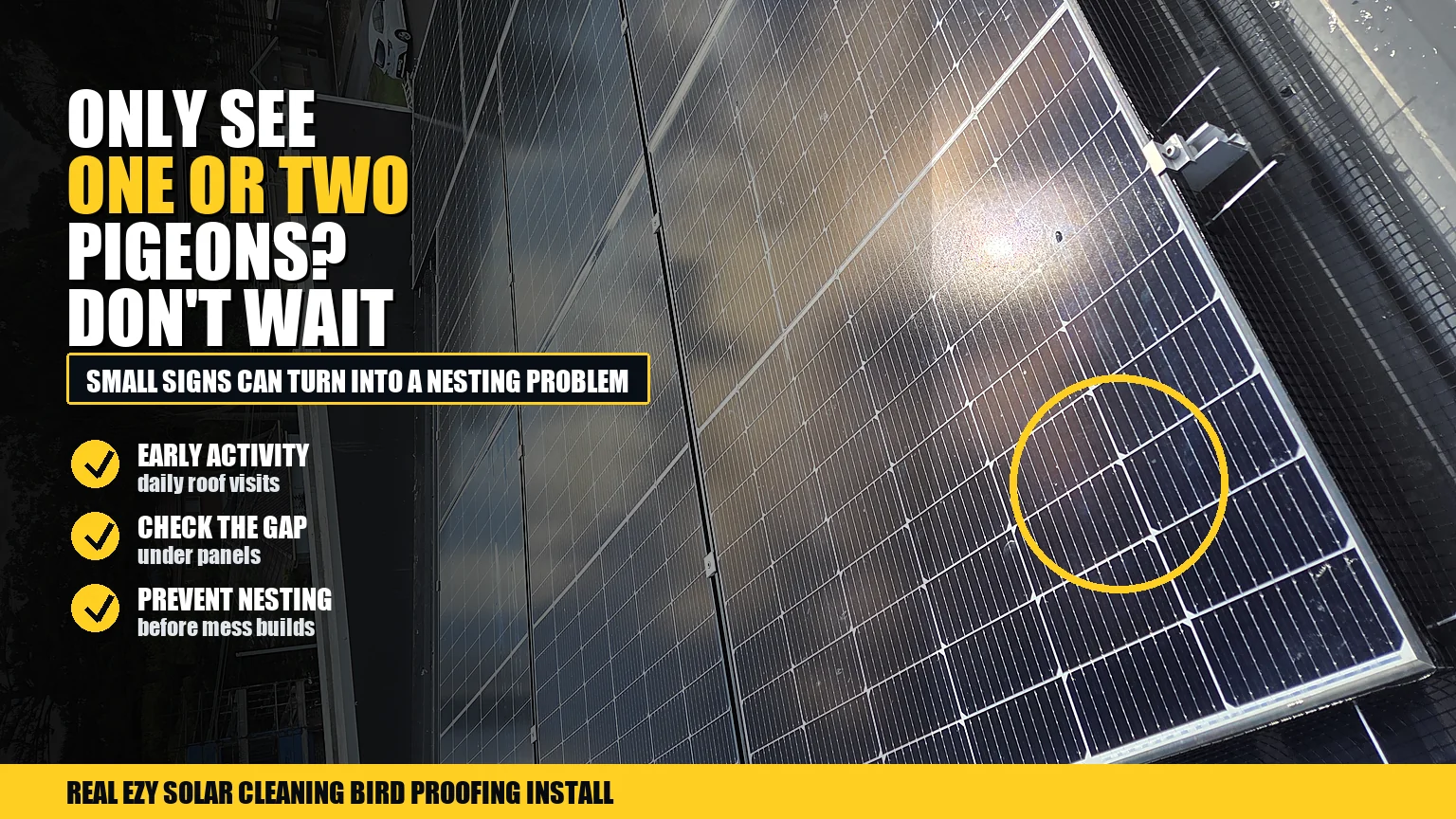
Seeing one or two pigeons on your roof does not always mean you need bird mesh immediately. But if those pigeons keep returning to the same solar panels, sit there most mornings, or disappear underneath the panel edge, it is worth taking seriously.
In Brisbane, small pigeon problems can grow quietly because nesting activity can continue for much of the year. Homeowners often wait because the birds seem to leave for a while, then the same birds return during another nesting cycle. By the time the noise, droppings, and gutter mess are obvious, the clean-up is usually bigger.
One pigeon passing through is different from a pattern
A bird landing on the roof once is normal. Pigeons move around suburbs, rest on high points, and may use rooflines briefly. The concern starts when you see the same pattern: pigeons landing near the panels each day, walking along the lower edge, or going under the solar array.
Pigeons are location-oriented. If they decide your roof is a useful nesting spot, they may keep returning even after being scared away. They may also leave between nesting cycles, which can make the problem look like it has solved itself.
Signs the one or two pigeons are not random
The best thing to watch is behaviour. If birds are only passing over the roof, there may be nothing to do yet. If they are inspecting the same gap under the panels, the risk is higher.
- pigeons sitting beside the same panel row most mornings
- birds disappearing under the panel edge
- scratching, cooing, or movement sounds at sunrise
- droppings below one roof section
- twigs, feathers, or eggshells near gutters
- one gutter section becoming dirty faster than the rest
If several of these signs appear together, the birds may already be using the space under the panels.
Why early action can be easier
Early solar panel bird proofing is usually cleaner than waiting until birds are fully established. Before nesting material builds up, the job can be more straightforward. Once nests, droppings, and blocked gutters are involved, the service may also need debris removal and cleaning.
This is why prevention often makes sense when pigeons are becoming regular visitors. Bird mesh is not about panicking over one bird. It is about stopping access before the roof becomes a nesting site.
When monitoring is reasonable
If the birds are occasional and you have no noise, no droppings, and no signs of birds entering under the panels, you may choose to watch the roof for a short period. Check safely from the ground. On some homes, you may be able to look from the street and see whether there is daylight under the panel edge.
Do not climb onto the roof to inspect. Solar panels, roof tiles, and gutter edges can be dangerous, especially if you are trying to look underneath a panel array.
When bird mesh becomes the smarter option
| What you notice | What it suggests |
|---|---|
| One bird once | Probably monitor only |
| Same birds most mornings | Possible regular roof use |
| Birds entering under panels | Active access point |
| Noise at sunrise | Birds may be sheltering overnight |
| Droppings below one area | Repeated activity above that spot |
| Nesting material near gutters | Birds may already be nesting |
Why DIY deterrents are not the same as mesh
Many homeowners try fake owls, shiny objects, CDs, vinegar sprays, or noise devices before calling for help. These may appear to work briefly, but pigeons often ignore them once they learn there is no real threat.
Bird mesh works differently. It does not try to scare pigeons away from the whole roof. It physically blocks the sheltered gap under the solar panels so they cannot nest there.
What if the panels are already dirty?
If birds have left droppings on the panel glass, solar panel cleaning may be worth considering after the access issue is handled. Cleaning alone will not stop birds returning, but it can remove contamination once the source is blocked.
For more warning signs, read how to tell if birds are nesting under your solar panels and why pigeons like solar panels.
The bottom line
You do not always need bird mesh because one pigeon landed on the roof. But if one or two pigeons keep returning, entering under the panels, making morning noise, or leaving droppings in the same area, it is better to act early. Bird mesh is usually easiest before nesting becomes established.
FAQs
Is one pigeon on my roof a problem?
Not necessarily. The concern is repeated behaviour, especially around the same solar panels.
How do I know if pigeons are nesting?
Look for birds entering under panels, morning noise, droppings, feathers, twigs, and gutter mess below one area.
Will pigeons leave on their own?
They may leave temporarily, but pigeons often return to successful nesting sites later.
Can I wait and see?
Yes, if there are no signs of nesting. Watch for a pattern rather than one-off bird activity.
Does bird mesh stop pigeons landing on the roof?
No. It stops them getting under the solar panels, which is the nesting area that causes most of the problem.
A simple way to decide
If you are unsure, watch the roof for several mornings rather than making a decision from one quick sighting. Pigeons are often active early, so that is when the pattern is easiest to spot. Look for where they land, whether they walk toward the panel edge, and whether they disappear under the array.
If the same behaviour repeats, treat it as an early warning. A small number of birds can still create a real nesting problem if they have found a sheltered gap they like.