
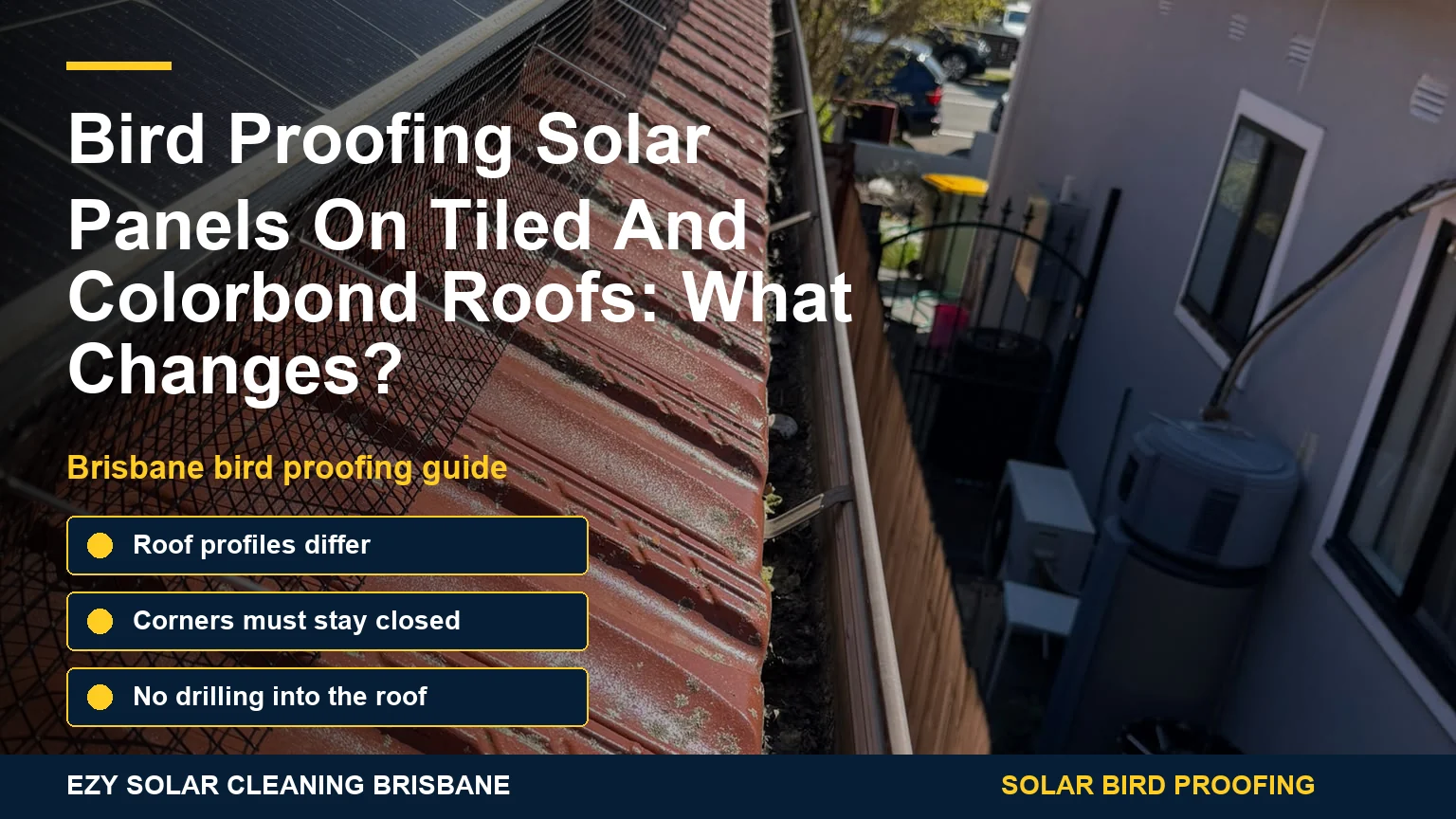
The purpose of solar panel bird proofing is the same on tiled and Colorbond roofs: close the exposed gap around the array so pigeons cannot get underneath. What changes is the roof profile, access method and the way the mesh must be shaped to create a neat, secure barrier.
A good installer should adapt the work to the roof rather than force the same mesh shape onto every property. The important details are full perimeter coverage, secure panel-edge attachment, careful corners and no drilling into either roof type.
How tiled roofs affect the mesh shape
Concrete and terracotta tiles have raised and lowered sections. The bottom edge of the mesh needs to follow that uneven profile closely enough that pigeons cannot push through a gap.
Tiles can also be fragile. Cracked or displaced tiles may create water-entry problems unrelated to the mesh itself, so careful movement and roof access matter. Bird proofing should not involve screwing the mesh into the tile.
On some tiled roofs, deep channels require more detailed shaping. A strip that looks straight from the street may still leave openings where the tile profile drops away.
How Colorbond roofs differ
Colorbond and other metal roofs use ribs and pans rather than individual tiles. The mesh still needs to follow the roof profile around the array, particularly along lower edges where the ribs create repeated changes in height.
Metal roofs also need care to avoid scratches, dents and damage to protective coatings. Walking routes, tools and loose wire ends should be managed carefully. The bird mesh should be attached to the solar panel edge with suitable clips rather than drilled through the roof sheet.
What stays the same on both roof types
Regardless of the roofing material, a complete installation should address:
- every exposed side of the solar array
- rear edges that are difficult to see from the ground
- corners and changes in direction
- gaps between rows where birds can enter
- separate arrays on other roof faces or garages
- nests and loose debris beneath the panels
- secure mesh attachment without drilling
Professional solar panel bird proofing in Brisbane should be scoped around the actual system layout and roof condition.
Why corners deserve special attention
Corners are where the direction of both the panel frame and roof profile changes. If the mesh is cut poorly, folded loosely or joined without enough care, a small opening can remain.
Pigeons do not need the entire side to be open. One weak corner or an overlooked gap between panel rows may be enough. This is why neat appearance and functional closure often go together: carefully shaped mesh is less likely to leave obvious loose sections.
Comparing tiled and metal roof considerations
| Installation detail | Tiled roof | Colorbond roof |
|---|---|---|
| Surface profile | Individual raised and lowered tiles | Repeating metal ribs and pans |
| Access concern | Avoid cracking or moving tiles | Avoid scratches, dents and coating damage |
| Mesh shaping | Follow tile channels closely | Follow rib profile and lower-edge changes |
| Roof fixing | No drilling into tiles | No drilling through metal sheets |
| Existing condition | Check cracked or displaced tiles | Check corrosion, loose screws or damaged coating |
This table describes general differences. Individual roofs vary by pitch, age, panel height and mounting layout.
Does one roof type need bird proofing more than the other?
Pigeons can nest under solar panels on either roof type. The deciding factor is whether they can access a sheltered gap, not whether the roof is tiled or metal.
Some arrays sit lower to the roof, while others leave more space. Roof orientation, nearby buildings, trees and previous pigeon activity also influence what the birds choose. Two neighbouring homes with similar roofs can still have different outcomes.
What existing bird mess changes
When birds have nested beneath the panels, the job may include more than mesh. Sticks, feathers, droppings and organic debris may need to be removed. Gutters below the nesting area can also become contaminated or blocked.
Cleaning the panel glass does not remove material under the array, and installing mesh does not clean the glass. Ask for the scope to separate nest removal, panel cleaning and perimeter proofing.
The article on solar panel cleaning after nest removal explains why these are connected but distinct tasks.
What photos can reveal before quoting
Safe ground-level photographs can show the number of arrays, roof height, roof material and approximate panel layout. They may not reveal every hidden edge, but they help identify obvious access issues before an on-site assessment.
Useful photos include a wide image of the roof, each separate array and the areas where pigeons land or droppings collect. Do not climb onto the roof for close-ups.
Questions to ask about workmanship
Before accepting a quote, ask:
- Is the full perimeter included?
- Are separate garage or rear-roof arrays included?
- How will the mesh follow the tile channels or metal ribs?
- Will any drilling be used?
- What mesh and clip materials are specified?
- Are nests and loose debris removed?
- Will completion photos be supplied?
- Is panel cleaning included or separate?
The existing article on what a professional bird-proofing job includes provides a broader checklist.
Why material choice matters in Brisbane
Roof surfaces experience strong heat and UV exposure. Cheap plastic mesh and clips can soften, sag or become brittle. Chicken wire can corrode and stain roof surfaces. Suitable coated stainless steel mesh and stainless steel clips provide a more appropriate long-term approach.
Material alone is not enough. Excellent mesh can still fail if the installer leaves a corner, row gap or second array open.
FAQ
Can solar bird mesh be fitted to a tiled roof?
Yes. It needs to be shaped to the tile profile and installed without drilling into the tiles.
Can it be installed on Colorbond roofing?
Yes. The mesh follows the metal roof profile and should be attached at the panel edge without drilling through the roof sheet.
Is a metal roof easier than a tiled roof?
Not always. Access, pitch, panel layout and roof condition can matter more than the material alone.
Will the mesh scratch Colorbond?
Careful shaping and workmanship are important. The installer should avoid sharp loose ends and protect the roof surface during access.
What if some tiles are already cracked?
Existing roof damage should be documented and addressed appropriately rather than hidden by the mesh work.
Do garage panels need to be included?
They should be assessed. Pigeons may move to an unprotected garage array if only the main roof is closed.