
If you’ve noticed pigeons constantly sitting on your roof or hearing scratching and cooing early in the morning, you might be wondering:
why do pigeons like solar panels so much?
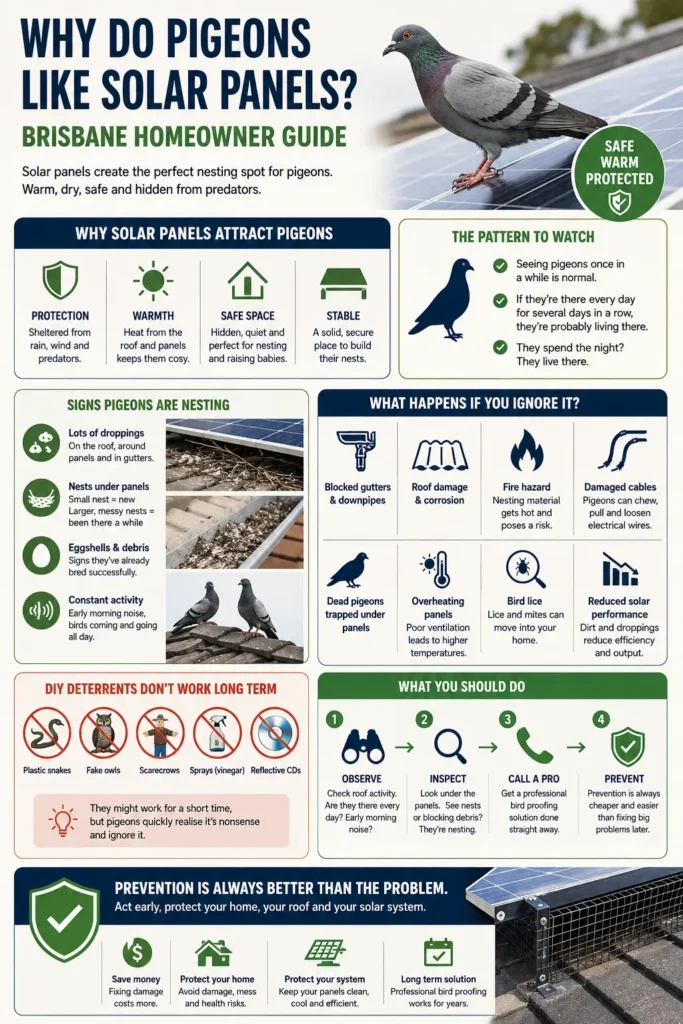
And honestly, after years of working on roofs across Brisbane, the answer is pretty simple:
solar panels create almost the perfect nesting environment for pigeons.
A lot of homeowners assume the birds are “just hanging around”, but in many cases, they’re actually living underneath the panels.
And once pigeons settle in, the problem usually gets worse over time if nothing is done about it.
Why Solar Panels Are So Attractive to Pigeons
The gap between the roof and the solar panels creates a protected little cavity underneath the system.
From a pigeon’s perspective, it’s honestly a pretty ideal place to build a nest.
Unlike trees, which move around in the wind and are exposed to weather, the space under solar panels stays:
- dry
- warm
- stable
- protected from predators
We regularly see pigeons choosing solar panels because the area underneath helps protect:
- eggs
- baby birds
- nesting materials
from birds like:
- crows
- magpies
- other predators
The panels also trap warmth underneath, especially on Brisbane roofs that get a lot of sun during the day.
That warmth, combined with protection from rain and wind, makes the area feel safe for nesting.
This is one of the main reasons so many Brisbane homeowners eventually end up needing solar panel bird proofing once pigeons move in.
Pigeons Don’t Usually Leave Forever
One of the biggest misunderstandings homeowners have is thinking:
“The pigeons disappeared, so the problem solved itself.”
But pigeons are extremely location-oriented.
If they successfully nested under your panels once, there’s a very high chance they’ll come back again later.
We’ve seen plenty of situations where homeowners noticed:
- a couple of pigeons
- a bit of noise
- maybe a small nest
…and then the birds disappeared for a while.
The homeowners assumed the problem was over.
Then a few months later, the pigeons came back again during the next nesting cycle — often with even more birds.
Over time, the nesting problem usually gets bigger:
- more pigeons
- larger nests
- more droppings
- more mess
- more roof contamination
This is one of the reasons we always recommend acting early instead of waiting for the problem to become severe.
We talked more about this in our guide on what happens if birds nest under solar panels.
Why Some Homes Get More Pigeons Than Others
There’s no single roof type that pigeons seem to prefer.
We see nesting problems on:
- tiled roofs
- Colorbond roofs
- single-storey homes
- double-storey homes
But one pattern we HAVE noticed over the years is that pigeons often seem to prefer higher homes.
For example:
if there’s a street with mostly single-storey houses and one double-storey home in the middle, the pigeons will often choose the taller property.
Not always — but often.
The higher roofline probably feels:
- safer
- more protected
- harder for predators to access
That said, plenty of single-storey Brisbane homes still end up with serious nesting problems too.
Sometimes The Pigeons Come From Nearby Homes
One thing many homeowners don’t realise is that pigeon problems often spread locally.
We’ve seen cases where:
- one homeowner installs bird proofing
- the pigeons get blocked out
- and then the birds immediately move to nearby houses
So sometimes people feel like:
“The pigeons suddenly appeared out of nowhere.”
But in reality, the birds were probably already nesting nearby and simply moved to the next available roof.
This is another reason why prevention is usually better than waiting for the problem to start.
Many Brisbane homeowners now install bird proofing before pigeons become established.
Signs Pigeons Are Already Living Under Your Solar Panels
A lot of people assume pigeons are just randomly landing on the roof.
And yes — sometimes they are.
But there’s a big difference between:
- occasional bird activity
and - birds actually nesting under the panels
Normally, if pigeons are:
- sitting on the roof every day
- constantly flying in and out
- making noise early in the morning
- spending the night there
…they’re probably living underneath the system.
One of the easiest ways to check is by looking underneath the panels.
If you can safely see the gap underneath, you should normally see daylight passing through.
But if you notice:
- large dark clumps
- nesting material
- debris blocking the gap
then there’s a good chance nests are already there.
We covered this in more detail in our guide on how to tell if birds are nesting under your solar panels.
What Happens If You Ignore The Problem?
This is where things can get expensive.
At the start, the problem usually seems small:
- one nest
- a couple of birds
- a bit of noise
But over time, the build-up underneath the panels can become serious.
We’ve personally seen:
- blocked gutters
- blocked downpipes
- roof corrosion
- scratched Colorbond roofing
- dead pigeons trapped under panels
- loose electrical cables
- overheating issues
- massive amounts of droppings
- bird lice problems inside homes
We’ve also seen solar systems underperform because the panels were heavily contaminated with droppings and debris.
This is one reason many homeowners combine bird proofing with solar panel cleaning.
And yes — dirty panels absolutely can impact output, especially when heavy contamination builds up over time.
Why Most DIY Pigeon Deterrents Fail
A lot of homeowners try temporary DIY fixes first.
We’ve seen:
- plastic snakes
- fake owls
- scarecrows
- vinegar sprays
- reflective tape
- CDs hanging from roofs
- noise machines
- cheap plastic mesh
Sometimes these things might scare the birds away briefly.
But eventually, the pigeons realise:
- the owl isn’t real
- the snake never moves
- the noise doesn’t matter
- the vinegar washes away
- the plastic mesh is weak
And once pigeons have already nested under your solar panels, they’re usually very motivated to stay because that’s where:
- the nests are
- the eggs are
- the babies are
That’s why proper professional bird proofing installation is usually the only long-term solution.
Prevention Is Always Better Than Waiting
Honestly, the biggest piece of advice we’d give Brisbane homeowners is:
don’t wait for the problem to get bad.
Most pigeon problems start relatively small.
But because pigeons keep returning to the same nesting locations, the situation usually escalates over time if nothing is done.
If you already suspect pigeons are nesting:
- check the roof activity
- inspect underneath the panels if possible
- look for nests or debris
- listen for early morning noise
And if the nesting is already happening, it’s usually much cheaper and easier to solve early rather than waiting until:
- gutters overflow
- nests become massive
- cables get damaged
- roof contamination spreads
Prevention is almost always cheaper than repairs later.
Frequently Asked Questions
Solar panels provide pigeons with:
- warmth
- shelter
- protection from predators
- protection from weather
- stable nesting conditions
The gap underneath the panels creates a safe space that pigeons often return to repeatedly.
Yes. Pigeons are very location-oriented and often return to the same nesting spots year after year if access remains open.
The panels themselves don’t attract pigeons, but the sheltered gap underneath them creates an ideal nesting environment.
They can become a serious problem over time due to:
- droppings
- blocked gutters
- roof damage
- cable issues
- overheating risks
- hygiene concerns
The most effective long-term solution is properly installed solar panel bird proofing (link to: /solar-panel-bird-proofing/) that fully seals the gap underneath the panels while still allowing ventilation.