
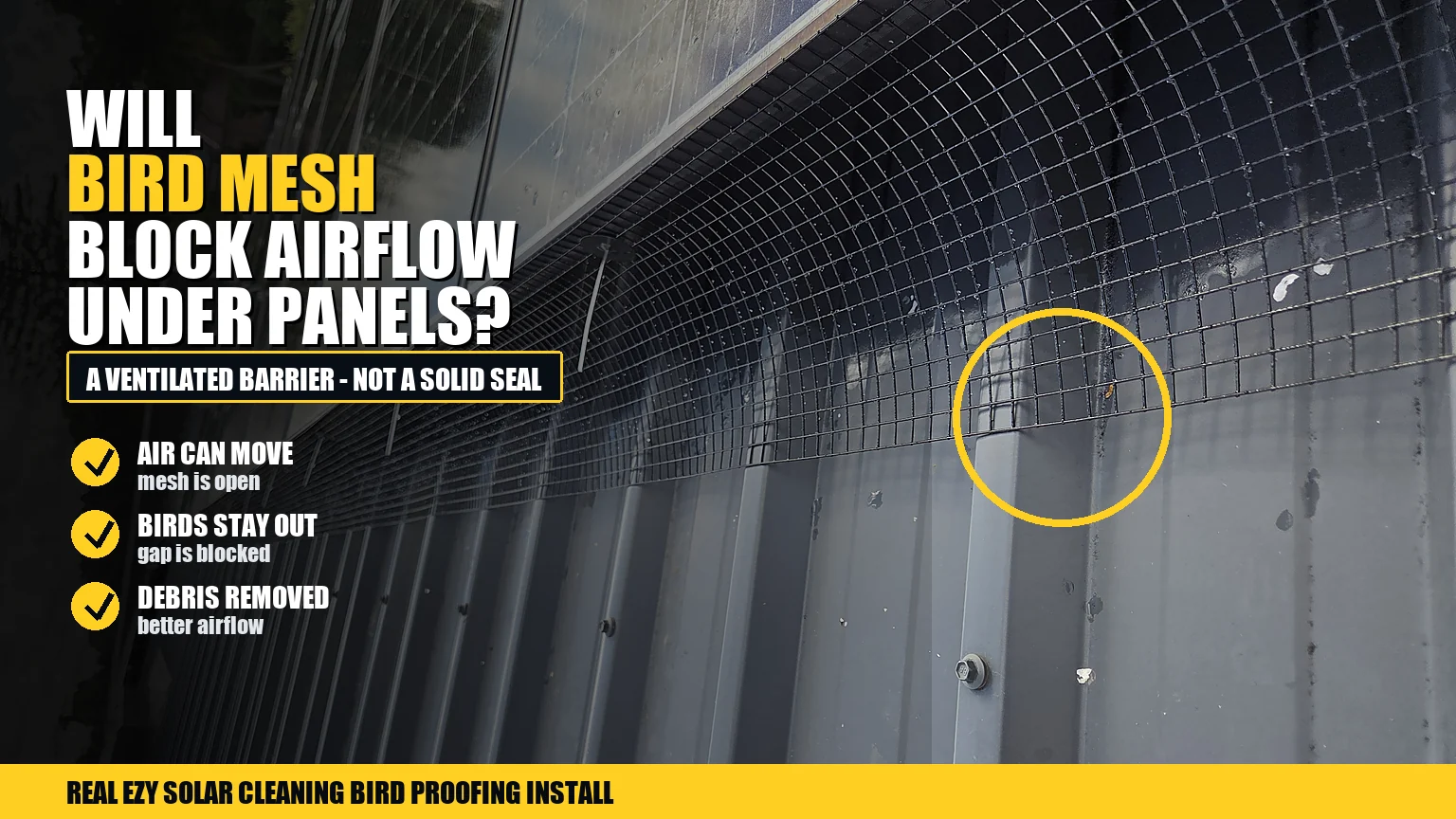
Properly installed bird mesh should not block normal airflow under solar panels. The purpose of the mesh is to stop birds getting into the sheltered cavity, not to seal the panels like a solid wall.
This is an important question for Brisbane homeowners because roofs can get extremely hot, especially through summer. It is reasonable to ask whether adding mesh around the panel edge will trap heat. The answer depends on the material and installation. Good mesh allows air movement while blocking pigeons. Poor materials or bad fitting can create problems.
Bird mesh is a barrier, not a solid cover
Solar panel bird mesh has openings in it. Those openings are small enough to stop pigeons entering, but they still allow air to move. The mesh sits around the outside edge of the solar array and closes the access point birds use for nesting.
It should not be installed as a sealed sheet under the panels. It should not be packed with material, stuffed into the gap, or fitted in a way that traps debris. A neat perimeter barrier is different from blocking the entire underside of the system.
Why airflow matters under panels
Solar panels naturally sit above the roof with a gap underneath. That space helps heat move away from the system. If birds build nests under the panels, airflow can actually become worse because nesting material, feathers, droppings, and debris can fill the cavity.
In that sense, pigeons can be more of an airflow concern than properly installed mesh. A roof full of nests and debris can restrict the space under the panels far more than a mesh perimeter barrier would.
What can cause airflow concerns
| Issue | Why it matters |
|---|---|
| Nesting material under panels | Can fill the cavity and restrict natural movement of air |
| Solid or unsuitable material | May block more of the gap than proper mesh |
| Plastic products sagging | Can deform and sit badly around panel edges |
| Mess sealed underneath | Debris remains in the area instead of being removed |
| Poor workmanship | Can leave blocked sections, gaps, or untidy coverage |
Why material choice matters
Quality solar panel bird proofing should use mesh that suits rooftop solar conditions. Brisbane heat and UV exposure can damage cheap plastic mesh and poor clips. If a material sags or breaks down, the issue is not only appearance. It can create gaps, uneven coverage, or sections that sit badly against the panels.
A professional job should use suitable mesh and clips, fitted around the panel perimeter without drilling into the panels or roof. The goal is to block birds while keeping the solar array neat and serviceable.
What about nests already under the panels?
If birds have already nested under the panels, the installer should remove accessible nesting material before installing mesh. This is important for cleanliness and airflow. Sealing old nests underneath is not a proper solution.
Where droppings are on the panel surface, solar panel cleaning may also be worth considering. Cleaning handles the visible contamination, while mesh stops pigeons returning underneath.
How to tell if the job is fitted properly
From the ground, you may not see every detail, but a proper job should look neat. The mesh should follow the panel edge, sit evenly, and not bulge out or hang loose. Corners should be shaped carefully, and the full perimeter should be protected.
You should not see obvious stuffed material, loose mesh, or big gaps. You also should not be told that airflow must be completely sealed off to stop birds. Bird proofing works by blocking entry, not by packing the panel cavity.
When homeowners worry after installation
Sometimes homeowners see pigeons still sitting on the roof after bird proofing and worry the mesh is not working. That is separate from airflow. Birds may return for a while to inspect their old nesting area, but if they cannot get under the panels, the mesh is doing its job.
For more context, read can pigeons come back after solar panel bird proofing and what mesh is best for solar panel bird proofing.
The bottom line
Good bird mesh should not block normal airflow under solar panels. It is a perimeter barrier with openings, designed to stop pigeons entering while allowing air movement. The bigger airflow problem is usually nesting material and debris under the panels, not properly fitted mesh.
FAQs
Does bird mesh seal the panels completely?
No. Proper mesh blocks bird access while still allowing air to move through the openings.
Can poor bird proofing affect airflow?
It can if unsuitable material is used or if debris is left trapped under the panels.
Should nests be removed before mesh is fitted?
Yes. Accessible nesting material should be removed before the space is closed.
Is mesh better than blocking the gap with solid material?
Yes. Solid material is not appropriate because it can block airflow and look untidy.
Can dirty panels be cleaned during bird proofing?
Yes, panel cleaning may be recommended if droppings or grime are already on the glass.
What good airflow-friendly mesh looks like
Good mesh should look like a neat screen around the edge of the panels, not a sealed board or packed barrier. You should still be able to understand that air can move through the mesh openings. The purpose is to stop the bird’s body from getting through, not to close every tiny air path.
If an installer talks about stuffing material under the panels or sealing the underside completely, that is a warning sign. The better approach is a clipped perimeter barrier with debris removed first.