
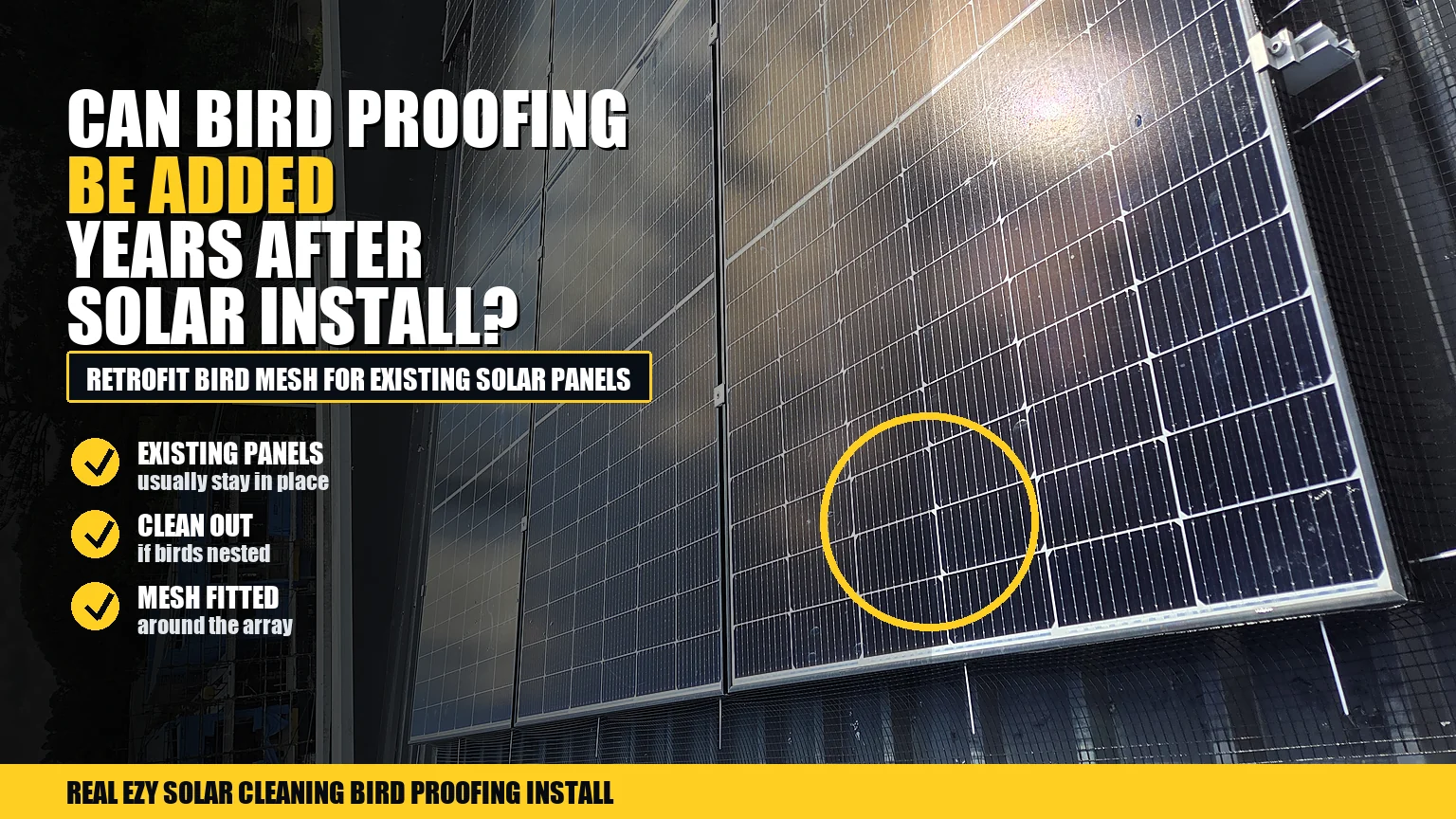
Yes, bird proofing can usually be added years after solar panels are installed. In fact, many Brisbane homeowners only organise it after they start hearing pigeons under the panels, seeing droppings around the house, or finding nesting material near the gutters.
Adding bird proofing later is common, but the job can be more involved than doing it before birds settle in. If pigeons have already been nesting, the installer may need to remove accessible nests and debris before fitting mesh around the panel perimeter.
Why people add bird proofing later
Many homeowners install solar panels without thinking about pigeons. The system looks complete, the roof looks tidy, and there may be no bird activity at the start. Then months or years later, pigeons discover the sheltered gap underneath.
Solar panels provide warmth, shade, shelter from rain, and protection from disturbance. In Brisbane’s climate, that space can be attractive for much of the year. Once pigeons start using it, they may return again and again.
What changes when birds are already nesting
If the panels are clear, adding solar panel bird proofing can be relatively straightforward. If birds are active, the job needs more care. Nests, feathers, droppings, eggshells, and debris may be sitting under the array.
That material should not simply be sealed under the panels. The accessible mess needs to be removed, and the installer should check whether gutters or panel surfaces have also been contaminated.
Does the solar system need to be removed?
In most cases, the panels do not need to be removed. Bird mesh is normally fitted around the perimeter of the solar array and attached to the panel frame with suitable clips. The work should avoid drilling into the panels or the roof.
Some roofs and layouts are more complex than others. Split arrays, double-storey access, garage panels, and awkward corners can all affect the time and planning required.
What the installer should check first
| Check | Why it matters |
|---|---|
| Panel layout | Every open edge and panel group needs consideration |
| Bird entry points | Birds may be entering from the least visible side |
| Nesting material | Loose debris should be removed before sealing |
| Gutters | Nests and droppings may have washed into one section |
| Panel condition | Droppings on glass may make cleaning worthwhile |
| Roof access | Safe access affects how the job is planned |
Can older solar panels still be protected neatly?
Usually, yes. A professional installation should still look neat on an existing system. The mesh should be shaped around corners and edges so it blends with the panel line rather than looking like a rough patch.
Quality materials matter on older systems. Brisbane UV and heat can damage cheap plastic products, so coated metal mesh and suitable clips are usually a better long-term choice.
Should cleaning be done at the same time?
If birds have been nesting for a while, cleaning may be useful. Nest debris and droppings can collect under the panels, around gutters, and on the panel glass. Solar panel cleaning can remove visible contamination, while bird proofing stops access underneath.
Cleaning is not always necessary on every job, but it should be considered when droppings are visible or when birds have been active for a long time.
Why waiting can make the job bigger
If birds are already present, waiting usually does not make the job easier. Pigeons may disappear temporarily, but they often return to the same location. Over time, nesting material can build, gutters can block, and droppings can spread to outdoor areas below the roofline.
For broader timing advice, read what time of year pigeons nest under solar panels in Brisbane and how long pigeons stay under solar panels.
The bottom line
Bird proofing can be added years after solar panels are installed, and it often is. The earlier it is done, the cleaner the job tends to be. If pigeons are already nesting, expect the work to include inspection, debris removal, mesh installation, and possibly cleaning where contamination has built up.
FAQs
Can bird mesh be added to old solar panels?
Yes. Existing systems can usually be bird proofed without removing the panels.
Will bird proofing damage my roof?
A proper installation should avoid drilling into the roof or panels and use suitable clips.
Is it too late if birds are already nesting?
No. Bird proofing can still be installed, but nests and loose debris may need to be removed first.
Should I wait until the next nesting season?
Brisbane can have pigeon activity through much of the year, so waiting may allow more mess to build up.
Can garage panels be bird proofed later too?
Yes. Any separate panel group should be checked if birds are active around the property.
Why older systems should include every array
Older solar systems are often not one simple panel group. Some homes have panels on the main roof, garage, extension, or different roof faces. If bird proofing is added years later, each array should be checked rather than assuming only the largest section matters.
This is especially important if pigeons have already nested on the property. Once one space is blocked, birds may test nearby gaps. A complete inspection helps avoid solving one section while leaving another obvious nesting cavity open.
What homeowners should organise before the quote
Photos can make the quote more accurate. Safe ground-level photos of the front of the house, roof height, panel layout, garage panels, and any visible droppings or gutter mess are useful. Do not climb onto the roof to get them. The aim is to give enough context for the installer to understand access, panel groups, and the likely level of bird activity.