
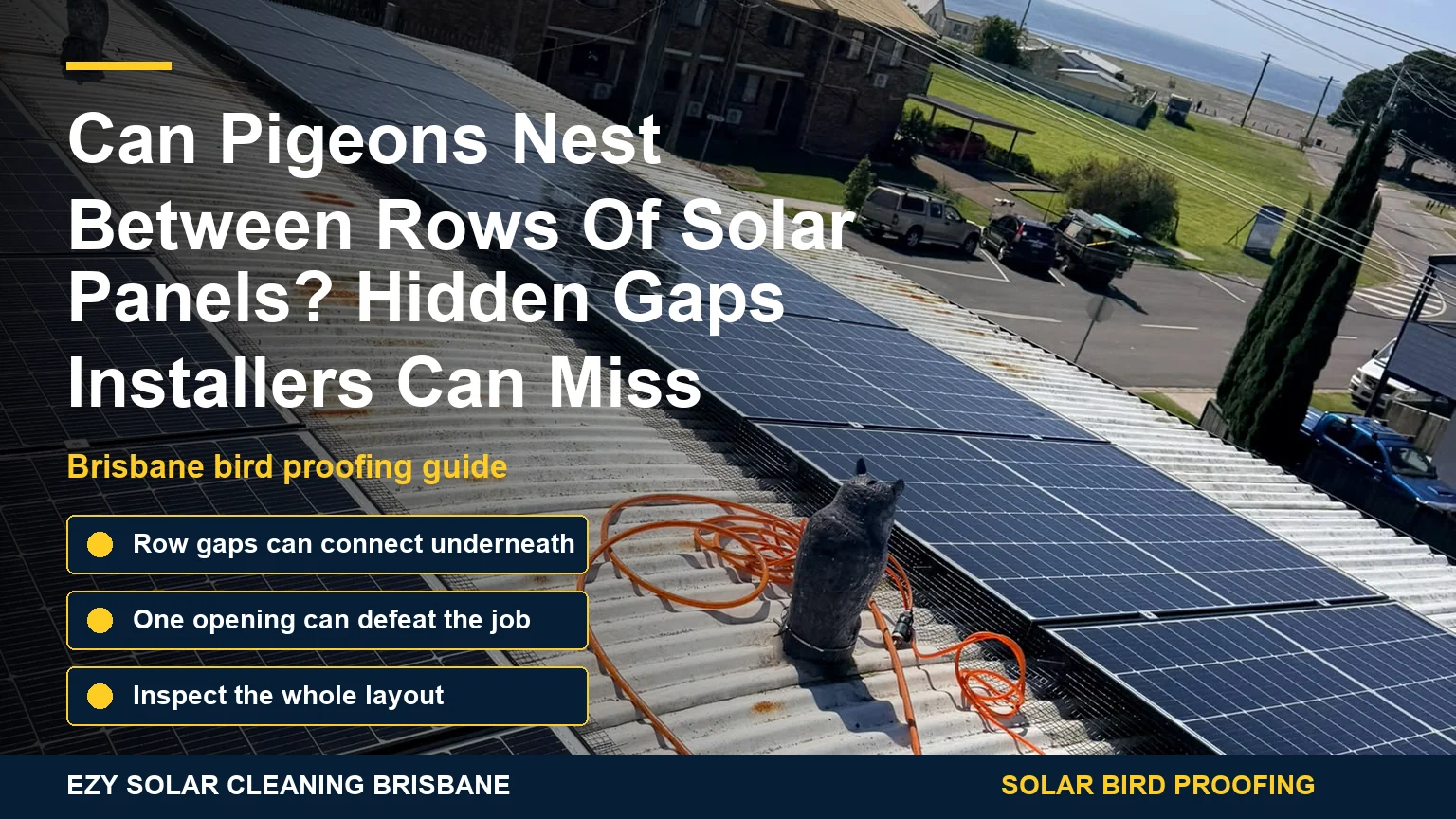
Yes, pigeons can use gaps between rows of solar panels when those gaps connect to the sheltered space beneath the array. They do not need to build a nest in the visible channel itself. A narrow-looking opening can be an entry route to a larger protected area under the panels.
This is one reason bird proofing should be planned around the complete solar layout. Closing only the outer front edge may leave row breaks, internal corners, raised sections or rear edges accessible.
Why panel layouts create unexpected entry points
Solar arrays are not always one simple rectangle. Roof shape, vents, skylights and available sunlight can produce separate rows, L-shaped layouts and small islands of panels. Each change in direction creates another edge that needs assessment.
From the ground, some internal gaps appear too small or too exposed. At roof level, the opening may lead directly beneath the panel frame. Pigeons are persistent when they already know shelter is available.
Common hidden access points include:
- a channel between two panel rows
- the rear edge on the high side of the roof
- an inside corner in an L-shaped array
- a step where panel heights change
- spaces around conduit or mounting hardware
- the end of a row concealed by the viewing angle
- a separate array on a garage or extension
The difference between a harmless channel and an entry route
Not every visible line between panels is a pigeon opening. The important question is whether the gap connects to the underside of the array.
| Layout feature | What needs checking |
|---|---|
| Narrow gap between frames | Whether birds can reach the open underside |
| Two rows at different heights | Whether the step leaves an exposed edge |
| L-shaped array | Whether the internal corner is closed neatly |
| Panels around a roof vent | Whether the interrupted perimeter has openings |
| Separate garage array | Whether birds can relocate there after the house is protected |
A proper roof-level assessment identifies the functional perimeter rather than relying only on the rectangle visible from the street.
What happens when one gap is missed
Bird mesh is a physical exclusion system. It works only when the usable access points are closed. If one corner or row gap remains open, pigeons may keep entering through that location even though most of the array looks protected.
The result can be confusing for the homeowner: the mesh appears to be present, yet cooing and droppings continue. In some cases, birds simply shift from the blocked edge to the missed opening.
This is why the completed job should be checked around the entire layout and supported with photographs. The guide to common bird-proofing mistakes covers other workmanship issues that can undermine otherwise good materials.
How mesh should follow complex panel rows
Suitable coated stainless steel mesh can be shaped around straight edges, corners and changes in the roof profile. Stainless steel clips secure it to the panel frame without drilling into the panels or roof. The installer needs to keep the barrier neat while ensuring it reaches the roof surface closely enough to prevent entry.
On tiled roofs, the mesh must follow the highs and lows of the tile profile. On metal roofs, it must account for ribs and changes in sheet shape. Internal row edges may require the same care as the visible outer edge.
The article explaining how bird mesh is attached without drilling provides more detail on the attachment method.
Why “price per metre” does not tell the whole story
Perimeter length matters, but complexity also affects the work. A compact rectangular array may be simpler than a smaller system split around roof features. More corners, internal edges and separate arrays can require extra shaping and checking.
When comparing quotes, ask whether the provider measured only the obvious outer boundary or assessed every exposed edge. A cheaper quote can be poor value if it excludes the garage array or leaves the channel between rows untreated.
The main solar panel bird proofing service explains the materials and installation approach used for long-term exclusion.
What homeowners should show in quote photos
Wide ground-level photos are useful because they show the relationship between rows. Include the whole roof face where possible, not only the corner where a pigeon was seen. If the property has panels on another roof section, photograph that too.
Helpful details include:
- approximate panel count
- number of separate groups or arrays
- tile or metal roof
- single or double-storey access
- where birds enter or disappear
- any existing mesh around part of the system
- whether the problem continued after earlier work
Never climb onto the roof to obtain better photos. An installer can confirm hidden edges safely during assessment.
When a return inspection is sensible
If bird noise or entry continues after mesh was installed, arrange a check rather than assuming the birds are trapped or the entire system has failed. Returning pigeons may simply be landing and inspecting their previous shelter. However, repeated disappearance beneath the panels suggests an opening needs attention.
Completion photos, a written scope and clear identification of every array make this easier to resolve.
FAQ
Can pigeons fit through small gaps between panels?
They can use surprisingly modest openings if those openings lead beneath the array. The exact layout needs inspection.
Does mesh go between every individual panel?
Usually the barrier follows exposed access edges, not every seam between touching panel frames. Internal open rows may need separate treatment.
Can only the front edge be protected?
Partial coverage can leave rear, side or internal openings usable. Full access control is the goal.
Are complex arrays more expensive to bird-proof?
They can require more mesh, corners, shaping and access time, even when the panel count is modest.
Can birds move to a second array?
Yes. A garage, extension or another roof face should be assessed so the birds are not simply displaced.
How do I confirm the hidden edges were completed?
Ask for a clear scope and completion photos showing corners, rear edges and separate rows where practical.