
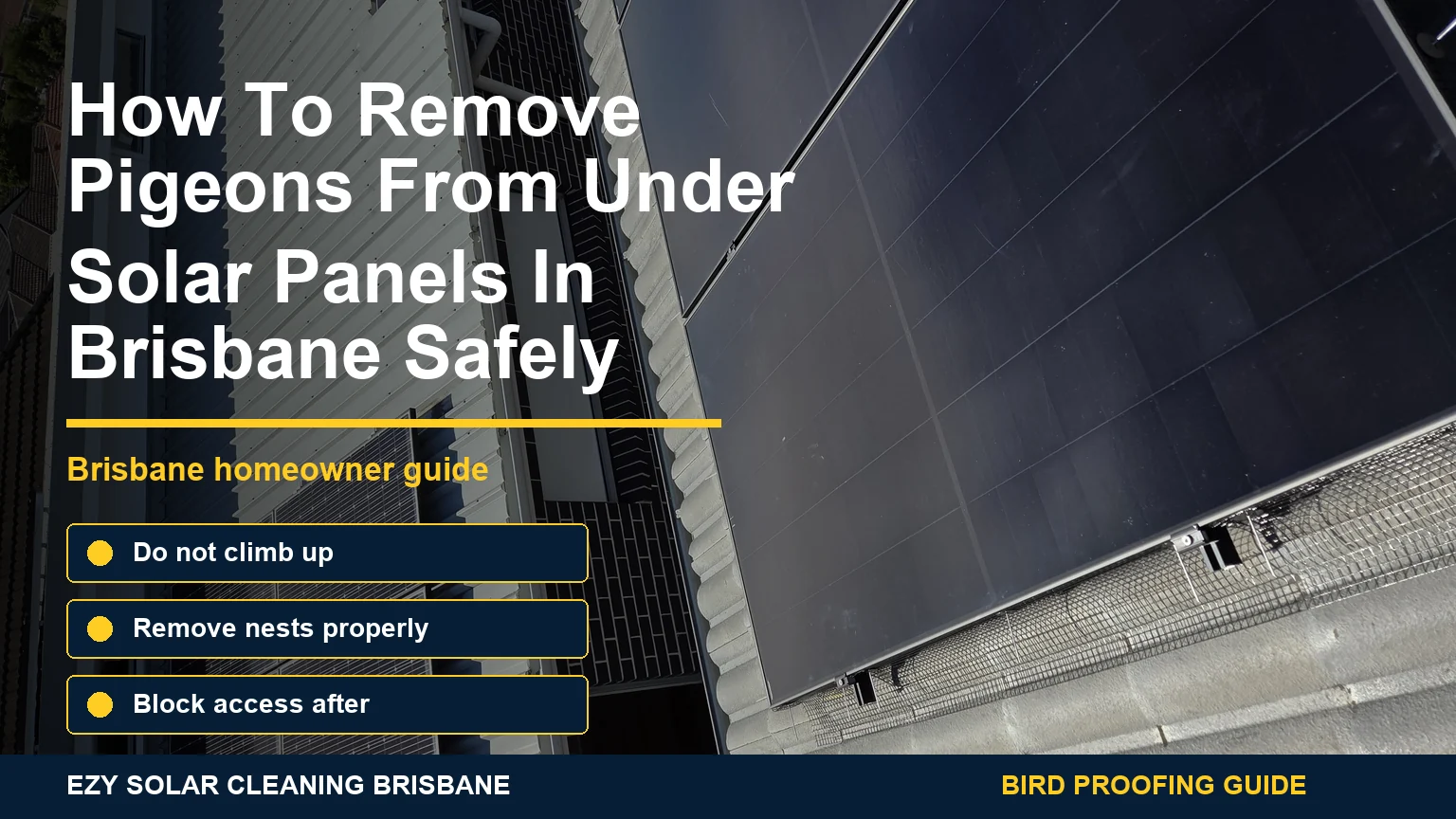
The safest way to deal with pigeons under solar panels is to avoid climbing onto the roof yourself and arrange a proper inspection. If pigeons are nesting underneath the panels, the job is usually not just “removing birds”. It may involve clearing nests and debris, checking for droppings or blocked gutters, cleaning affected areas, and installing mesh so the birds cannot keep returning to the same sheltered space.
Brisbane homeowners often notice the problem through noise first. Cooing early in the morning, scratching, flapping, or birds repeatedly landing near the same panel edge can all suggest that pigeons are using the gap under the solar array.
Do not climb onto the roof to remove pigeons
It is understandable to want the problem gone quickly, especially if the noise is waking you up. But rooftop work is risky, and solar panels add another layer of difficulty. Panels can be slippery, hot, fragile, and hard to move around safely. Trying to scare birds out or pull nesting material from the edge can put you in a dangerous position.
From the ground, you can still gather useful information. Look for birds entering under the panels, droppings below one section of roof, feathers, nesting material in gutters, or repeated bird movement at sunrise. These signs are enough to explain the issue when requesting help.
Why pigeons choose solar panels
Pigeons like the gap under solar panels because it offers warmth, shade, shelter from rain, and protection from predators. It is also more stable than a tree branch because the panel structure does not move much in wind.
Once pigeons successfully use a roof, they can become location-oriented. They may disappear for a while and then return later, which makes homeowners think the problem fixed itself. In reality, the same roof can be reused again during another nesting cycle.
What professionals usually check
A professional check should look at where the birds are entering, how much nesting material is present, whether droppings have built up, and whether gutters or panel edges are affected. It should also consider the panel layout. Some homes have more than one array, such as main roof panels and garage panels, and pigeons may move from one to the other if only part of the system is protected.
| What is found | Why it matters | Likely next step |
|---|---|---|
| Birds entering one edge | Active access point | Block the perimeter with mesh |
| Nesting material underneath | Birds have been using the space | Remove debris before bird proofing |
| Droppings on panels or roof | Cleaning may be needed | Clean affected areas after access is blocked |
| Blocked gutter section | Nest or droppings may be washing down | Check the roof area above |
| Multiple panel arrays | Birds may move between areas | Consider protecting all relevant arrays |
Why removal alone is often not enough
If pigeons are only scared away, they may come back. If nests are removed but the gap remains open, they may rebuild. If the panels are cleaned but access remains open, the mess may return.
That is why solar panel pigeon proofing is usually the long-term part of the solution. The service focuses on blocking access under the panels with fitted mesh and clips.
For Brisbane homes, professional solar panel bird proofing should use durable mesh, secure clips, and no drilling into the panels or roof. Nest and debris removal may be needed before the mesh is installed.
What about cleaning afterwards?
Cleaning depends on how much mess is present. Light bird activity may leave only minor droppings. Long-running nesting can leave heavy contamination, dead birds, bird lice, blocked gutters, and unpleasant smells. In those cases, solar panel cleaning after bird nest removal may be important for the panel surface and surrounding roof area.
Cleaning is not a magic performance guarantee, but it can remove droppings, grime, and organic build-up that should not be left sitting on the panels.
What not to rely on
Fake owls, fake snakes, CDs, reflective tape, vinegar spray, and ultrasonic devices may seem worth trying. Some homeowners report that these methods appear to work briefly. The problem is that pigeons often get used to them, especially when the sheltered space under the panels is still available.
If pigeons are already nesting, the physical access point matters more than the scare tactic. A fitted barrier is usually the more practical solution.
When to act
It is better to act when the signs are clear rather than waiting for the problem to grow. Brisbane’s warm climate means pigeon activity can continue for much of the year, and there is not a strong off-season. Waiting can allow more nests, droppings, and gutter mess to build up.
If you are unsure whether the issue is active nesting or occasional birds, take safe ground-level photos and ask for advice. The contact page is useful when you are ready to organise a quote or inspection.
FAQ
Can I remove pigeons from under solar panels myself?
It is not recommended. Roof access is risky, and the issue often involves nests, droppings, debris, and access points that need proper treatment.
Will pigeons leave on their own?
They may leave temporarily, but pigeons often return to a successful nesting location later.
Does cleaning remove the pigeon problem?
Cleaning removes mess. It does not block access under the panels. Bird proofing may be needed to stop repeat nesting.
What is the best way to stop pigeons under panels?
A fitted mesh barrier around the panel perimeter is usually the practical long-term solution when pigeons are nesting underneath.
Should nests be removed before mesh is installed?
Yes, nests and debris should be removed where required before the barrier is fitted.
Are deterrents enough?
Deterrents may work briefly, but they often fail when pigeons still have access to a warm, sheltered nesting space under the panels.