
If you’re researching solar panel bird proofing, you’ve probably noticed there are dozens of different mesh products available.
Some are stainless steel.
Some are plastic.
Some look like standard chicken wire.
And if you’re not familiar with bird proofing systems, it’s easy to assume that all mesh is basically the same.
Unfortunately, that’s not the case.
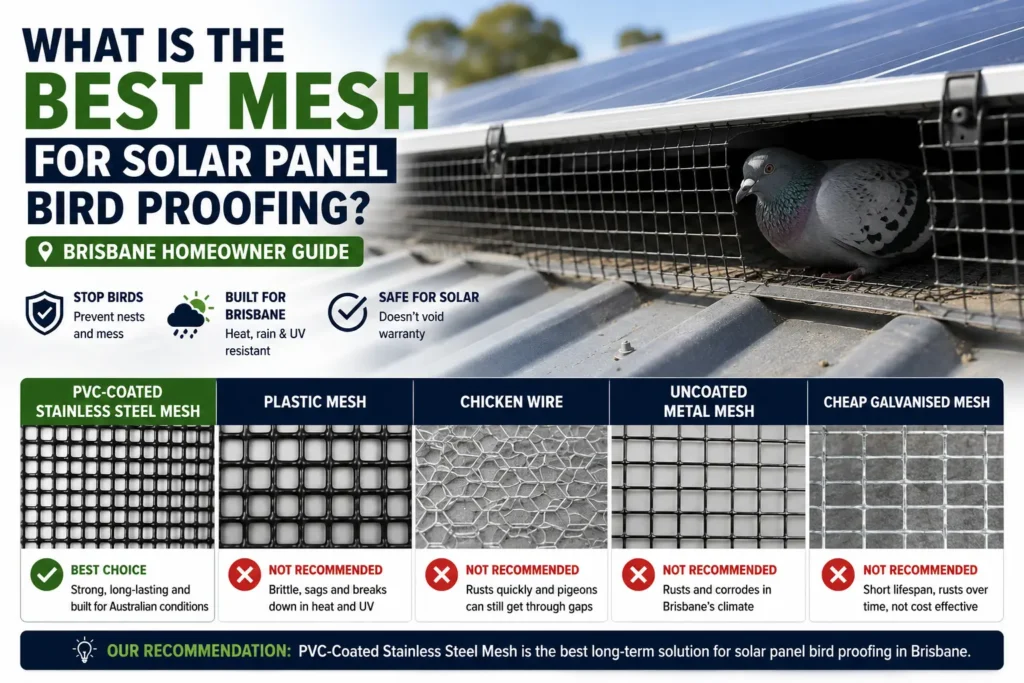
Over the years, we’ve seen plenty of bird proofing installations fail because the wrong materials were used. In many cases, the problem wasn’t the installation itself. The problem was the mesh.
So what is the best mesh for solar panel bird proofing?
Based on our experience working on roofs across Brisbane, Ipswich, Redlands and the Gold Coast, PVC-coated stainless steel mesh is by far the best option for long-term bird proofing.
Let’s look at why.
Why The Type Of Mesh Matters
The entire purpose of bird proofing mesh is to block access underneath the solar panels.
Once birds lose access to that sheltered space, they usually move on and look elsewhere.
However, if the mesh:
- Rusts
- Breaks
- Sags
- Pulls away from the panels
- Becomes brittle
Then the birds eventually find a way back in.
This is why choosing the right mesh is just as important as choosing the right installation method.
We discuss the installation side of things in DIY vs Professional Solar Panel Bird Proofing Installation: What Brisbane Homeowners Should Know.
What We Look For In A Good Bird Proofing Mesh
Not all mesh products are created equal.
When evaluating bird proofing mesh, there are several characteristics that matter.
Stainless Steel Core
The mesh should have a stainless steel base material.
Stainless steel provides:
- Strength
- Corrosion resistance
- Long-term durability
- Resistance to bird damage
The mesh needs to be strong enough to withstand years of exposure to weather while remaining securely in place.
PVC Coating
This is one of the most important features.
In our experience, PVC-coated stainless steel offers the best balance of durability and longevity.
The PVC coating helps protect the mesh while maintaining flexibility and appearance over time.
It’s also better suited to Australian conditions than many cheaper alternatives.
The Right Hole Size
The openings in the mesh need to be carefully sized.
If the holes are too large, birds may be able to squeeze through or gain access underneath the panels.
If the holes are too small, the mesh becomes harder to work with and may affect airflow.
Quality bird proofing mesh strikes the right balance.
The Right Balance Of Strength And Flexibility
This is something many homeowners don’t think about.
Mesh shouldn’t be:
- Too stiff
- Too thin
- Too flexible
- Too rigid
A quality product needs enough flexibility to follow the shape of the solar panel array while remaining strong enough to hold its form for years.
After testing numerous products over the years, we’ve found that quality PVC-coated stainless steel mesh consistently delivers the best results.
Comparison Table: Common Bird Proofing Mesh Options
There are several types of mesh commonly used for bird proofing. The table below compares the most common options.
| Mesh Type | Durability | Bird Resistance | Weather Resistance | Recommended |
|---|---|---|---|---|
| PVC-Coated Stainless Steel Mesh | Excellent | Excellent | Excellent | ✅ Yes |
| Plastic Mesh | Poor | Poor | Poor | ❌ No |
| Chicken Wire | Poor | Moderate | Poor | ❌ No |
| Uncoated Metal Mesh | Moderate | Good | Poor | ❌ No |
| Cheap Galvanised Mesh | Poor | Moderate | Poor | ❌ No |
As you can see, PVC-coated stainless steel mesh is the clear winner when it comes to durability, weather resistance and long-term performance.
Why We Don’t Recommend Plastic Mesh
One of the most common DIY mistakes we see is homeowners using plastic mesh.
At first glance, it seems like a sensible option.
It’s:
- Cheap
- Easy to find
- Lightweight
- Easy to install
The problem is that Brisbane’s climate is incredibly harsh on plastic.
Roof spaces become extremely hot during summer.
Over time, plastic mesh can:
- Soften
- Lose shape
- Sag
- Become brittle
- Crack
We’ve seen installations where plastic mesh was only around a year old and was already starting to fail.
In several cases, the pigeons had simply pushed through weakened sections of the mesh and regained access underneath the solar panels.
Plastic Clips Cause Similar Problems
It’s not just the mesh itself.
The clips matter too.
We’ve seen homeowners install decent mesh using:
- Plastic clips
- Nylon clips
- Generic fastening systems
Unfortunately, these products often suffer from the same problems.
Once exposed to heat and UV for long periods, they can become:
- Soft
- Flexible
- Weak
- Brittle
This allows sections of mesh to loosen or detach.
That’s why professional bird proofing systems typically use specialised solar panel clips designed specifically for this application.
You can learn more about our installation approach on our Solar Panel Bird Proofing.
Why Chicken Wire Usually Fails
Another common DIY solution is standard chicken wire.
The thinking usually goes something like this:
“If it keeps chickens in, surely it will keep pigeons out.”
Unfortunately, the reality is often very different.
We’ve inspected bird proofing systems where standard chicken wire had:
- Rusted heavily
- Lost structural strength
- Started breaking apart
- Stained nearby roof surfaces
In some cases, corrosion from cheap wire products had already begun affecting surrounding roof areas.
Chicken wire may seem like a budget-friendly solution initially, but it often creates more problems than it solves.
Real Example: When Cheap Mesh Failed
One situation we see regularly involves homeowners who already have bird proofing installed but are still experiencing bird problems.
After inspection, the issue often turns out to be the materials.
We’ve seen plastic mesh that:
- Looked fine initially
- Softened in the Brisbane heat
- Lost tension
- Sagged between clips
Eventually the pigeons simply pushed through.
The homeowner paid for bird proofing once, only to pay again when the system failed.
This is one reason we believe it’s better to use quality materials from the start.
Does The Best Mesh Mean The Most Expensive Mesh?
Not necessarily.
The goal isn’t to buy the most expensive product available.
The goal is to use materials that are proven to survive:
- Heat
- UV exposure
- Rain
- Wind
- Bird pressure
In our experience, PVC-coated stainless steel consistently provides the best balance between performance, longevity and value.
What About DIY Bird Proofing Kits?
There are some good DIY bird proofing kits available.
If you’re planning to install one yourself, we’d strongly recommend choosing a kit that uses:
- PVC-coated stainless steel mesh
- Proper solar panel clips
- Materials designed specifically for solar bird proofing
Avoid:
- Plastic mesh
- Plastic clips
- Chicken wire
- Improvised fastening methods
We cover DIY installation considerations in DIY vs Professional Solar Panel Bird Proofing Installation.
How Long Should Good Bird Proofing Mesh Last?
A quality bird proofing system should last many years when properly installed.
The exact lifespan depends on:
- Materials used
- Installation quality
- Environmental conditions
- Maintenance
Final Thoughts
If you’re wondering what the best mesh for solar panel bird proofing is, our answer is simple.
PVC-coated stainless steel mesh is the best option we’ve found.
It offers:
- Excellent durability
- Strong resistance to weather
- Long-term performance
- Better protection against bird intrusion
Over the years we’ve seen plastic mesh fail, plastic clips deteriorate, and chicken wire rust away.
Quality materials may cost a little more upfront, but they usually save homeowners money and frustration in the long run.
Frequently Asked Questions
What is the best mesh for solar panel bird proofing?
PVC-coated stainless steel mesh is generally considered the best option because it combines strength, flexibility and long-term weather resistance.
Does plastic bird proofing mesh work?
It may work temporarily, but in our experience plastic mesh often softens, sags or deteriorates when exposed to Brisbane’s heat and UV conditions.
Can pigeons get through bird proofing mesh?
If the mesh is damaged, poorly installed or made from weak materials, pigeons can sometimes push through or gain access around it.
Is chicken wire suitable for solar panel bird proofing?
We generally do not recommend chicken wire because it can rust, deteriorate and lose strength over time.
What clips should be used for bird proofing?
Specialised solar panel clips designed specifically for bird proofing systems are usually the best option.
Will bird proofing mesh damage my solar panels?
No. When installed correctly using proper clips, bird proofing mesh should not damage the panels or roof.
Can I install bird proofing mesh myself?
Some homeowners choose to install DIY kits, but it’s important to use quality materials and follow proper installation methods.
How much does solar panel bird proofing cost?
Costs vary depending on system size, roof access and the extent of the nesting problem. Our guide on solar panel bird proofing cost explains pricing in more detail.